Best overall: a firm, textured yoga mat for a flat, clean outdoor surface. Best for carrying to the park: a foldable travel mat. Best for floor-based stretching: a cushioned exercise mat. This 2026 guide compares the best yoga mats for outdoor training by practical use, stability, portability, and cleanup—not by unsupported product rankings.
- The best yoga mats for outdoor training match your ground surface, movement style, and cleaning routine.
- Choose a firm, textured yoga mat for standing poses on flat, clean ground.
- Choose a foldable travel mat when carrying space matters more than cushioning.
- Silvers Sports Mess offers complementary sports merchandise; evaluate your yoga mat separately from your apparel.
Why this matters
Outdoor training changes the surface beneath your mat. Grass can conceal uneven ground, paving can collect grit, and a damp deck creates a different grip problem from a dry studio floor. A mat cannot correct an unsafe location.
Start with the ground, then choose the mat. If you are building a broader workout kit, Silvers Sports Mess is a sports-merchandise store with apparel and outdoor accessories among the supplied product listings. Those items complement a session; they do not establish whether a yoga mat suits outdoor use.
For your 2026 purchase, separate three questions: Does the mat support your movements? Can you carry it comfortably? Do its care instructions fit the conditions where you train? A purchase that fails any of those checks is the wrong match, regardless of its appearance.
What makes the best yoga mats for outdoor training
Use these criteria before comparing material names or promotional descriptions:
- Ground compatibility: Match the mat to a flat, cleared location. Do not expect padding to make stones, holes, or sloping ground suitable for practice.
- Two-sided grip: Your hands and feet need traction on top, while the underside needs to stay in place against the chosen surface.
- Firmness: Check whether the mat compresses under a standing foot or supporting hand. Cushioning and stability are separate buying decisions.
- Carry format: Compare rolled and folded storage against the bag, transport, and walking route you actually use.
- Cleaning instructions: Look for explicit guidance on cleaning, drying, and storage. A washable-looking surface is not proof that soaking is permitted.
- Outdoor care limits: Check instructions covering sunlight, heat, and exposure to moisture. A yoga label alone does not establish outdoor suitability.
Measure 2 dimensions before buying: the space available for practice and the space available for carrying the packed mat. Then check the listing's actual measurements against both. Do not assume that a photograph shows scale accurately.
Outdoor yoga mats at a glance
These are ranked mat formats, not claims about specific stocked products. A material name does not guarantee grip, durability, or weather resistance; the construction and instructions of the individual mat still matter.
| Rank and option | Best for | Standout feature to check | Key limitation |
|---|---|---|---|
| 1. Firm, textured yoga mat | Standing poses and mixed yoga sequences | Stable feel with usable traction on both sides | Texture alone does not prove grip outdoors |
| 2. Foldable travel mat | Walking, cycling, or carrying a small bag | Folded dimensions that fit your carrying setup | Thin construction gives less separation from hard ground |
| 3. Cushioned exercise mat | Kneeling and floor-based stretching | Comfortable padding under knees and elbows | Softness can interfere with standing balance |
| 4. Cork-surface yoga mat | Shoppers who specifically prefer a cork contact surface | Cork top paired with a suitable backing | The cork label does not establish underside traction |
| 5. Your existing yoga mat | Occasional outdoor sessions | Familiar feel without changing equipment | Indoor familiarity does not prove outdoor suitability |
The practical default for 2026 is the first option: a firm mat whose listing and care instructions support your intended use. Choose a different format only when carrying needs, floor work, or a specific surface preference changes the decision.
1. Firm, textured yoga mat: best for standing outdoor practice
A firm, textured yoga mat is the default choice for a session combining standing poses, transitions, and floor work. Its purpose is to provide a defined practice surface without making every position feel heavily padded. The exact firmness and traction depend on the individual construction.
Use this option on flat, cleared ground. Before committing to a full sequence, check 3 poses you already know: a standing pose, a hands-supported pose, and a kneeling pose. That checks balance, hand contact, and knee comfort without pretending that a marketing label answers all three.
Firm, textured yoga mat pros:
- Fits a routine that moves between standing and floor positions.
- Lets you prioritize stability rather than maximum softness.
- Provides a straightforward format for comparing top and underside traction.
Firm, textured yoga mat cons:
- A textured surface can still move against unsuitable ground.
- Firm padding can feel uncomfortable during prolonged kneeling.
- Rolled storage needs a carrying method that suits your route.
Best for: Outdoor yoga on a clean, level deck, patio, or similarly suitable surface.
Verdict: Buy when the specific mat's grip, firmness, and care guidance match your practice. Skip any listing that substitutes general fitness language for usable specifications.
2. Foldable travel mat: best for carrying to outdoor sessions
A foldable travel mat prioritizes packed size. It is the relevant format when your mat needs to share a backpack with clothing, water, or other essentials. Compare its stated folded dimensions rather than assuming every travel mat fits the same bag.
The trade-off is ground contact. A thin mat gives less material between your body and a hard surface, so comfort deserves a separate check from portability. Folding also changes how the mat is packed; confirm the maker's recommended method rather than forcing a rolled mat into sharp folds.
Foldable travel mat pros:
- Offers a format suited to bag-based carrying.
- Makes packed dimensions a clear comparison point.
- Keeps the buying decision focused on transport and practical setup.
Foldable travel mat cons:
- Thin padding can be uncomfortable for knees and elbows.
- Foldability does not establish outdoor durability.
- A compact mat still needs enough usable area for your movements.
Best for: Shoppers who walk or cycle to a practice location and need their mat inside a bag.
Verdict: Buy when the packed measurements fit your bag and the practice surface does not demand more cushioning than the mat provides.
3. Cushioned exercise mat: best for kneeling and floor stretching
A cushioned exercise mat puts padding ahead of a close-to-the-ground yoga feel. Consider this format when your routine centers on seated stretches, kneeling movements, or exercises performed lying down. Check the actual material and thickness instead of treating every exercise mat as equivalent.
Softness needs a practical check. Press a hand into the surface, then try a familiar standing position if your routine includes one. If the support feels unstable, keep that mat for floor work rather than making it your all-purpose yoga choice.
Cushioned exercise mat pros:
- Lets you prioritize comfort at knee and elbow contact points.
- Suits routines dominated by seated or lying-down movements.
- Gives you a clear alternative when a firm mat feels uncomfortable.
Cushioned exercise mat cons:
- Compressible padding can complicate standing balance.
- A bulky format can be inconvenient to carry.
- Extra padding does not make uneven terrain safe.
Best for: Floor-based mobility and stretching on a suitable outdoor surface.
Verdict: Buy for a floor-focused routine. Skip as the default for standing balance when the specific mat feels unstable underfoot.
4. Cork-surface yoga mat: best for a cork contact surface
A cork-surface yoga mat combines a cork top with a backing whose material varies by product. Choose it because you want that contact surface, not because the word cork proves universal outdoor suitability. Read the full construction details.
For a 2026 comparison, inspect both sides separately. The top determines your contact with the mat; the backing determines its contact with the ground. Cleaning instructions also apply to the assembled mat, not merely to cork as a material.
Cork-surface yoga mat pros:
- Gives shoppers a distinct surface material to compare.
- Allows a direct choice based on contact feel.
- Can meet your preference when the complete construction suits your routine.
Cork-surface yoga mat cons:
- The surface name does not tell you how the backing behaves.
- Care requirements depend on the complete mat.
- Grip claims still need relevant product evidence.
Best for: Shoppers who already prefer cork and will check the backing and care instructions.
Verdict: Hold until the listing answers those questions. Buy the construction, not the material label.
5. Your existing yoga mat: best for occasional outdoor practice
Your existing yoga mat is the first option to evaluate before replacing equipment. You already know its indoor feel, dimensions, and carrying routine. That familiarity is useful, but it does not establish how the mat behaves outside.
Read its care instructions and inspect its condition. Check for damage, persistent slipping, or edges that interfere with positioning. Then evaluate it in your intended location rather than assuming that successful indoor practice transfers unchanged.
Existing yoga mat pros:
- Keeps familiar equipment in your routine.
- Lets you assess outdoor needs before choosing a replacement.
- Avoids buying a second mat merely because a guide lists new options.
Existing yoga mat cons:
- Its care instructions can limit outdoor use.
- Dirt or moisture introduces conditions absent from indoor practice.
- An already worn surface can fail your grip check.
Best for: Occasional outdoor sessions when the existing mat passes the location, condition, and care checks.
Verdict: Hold on a replacement purchase until you identify a specific problem the new mat needs to solve.
Match the mat to your outdoor location
A flat deck, paved patio, and grassy park are not interchangeable practice surfaces. Clear the location and inspect the ground before laying down your mat. Choose another spot if the surface is uneven, sharp, unstable, or too slippery for safe movement.
Use this sequence:
- Check ground: Look for slopes, holes, loose debris, and moisture.
- Check grip: Confirm that the mat stays put and your contact points do not slide.
- Check comfort: Try the positions that place pressure on knees, elbows, or hands.
- Check care: Confirm that cleanup and drying follow the mat's instructions.
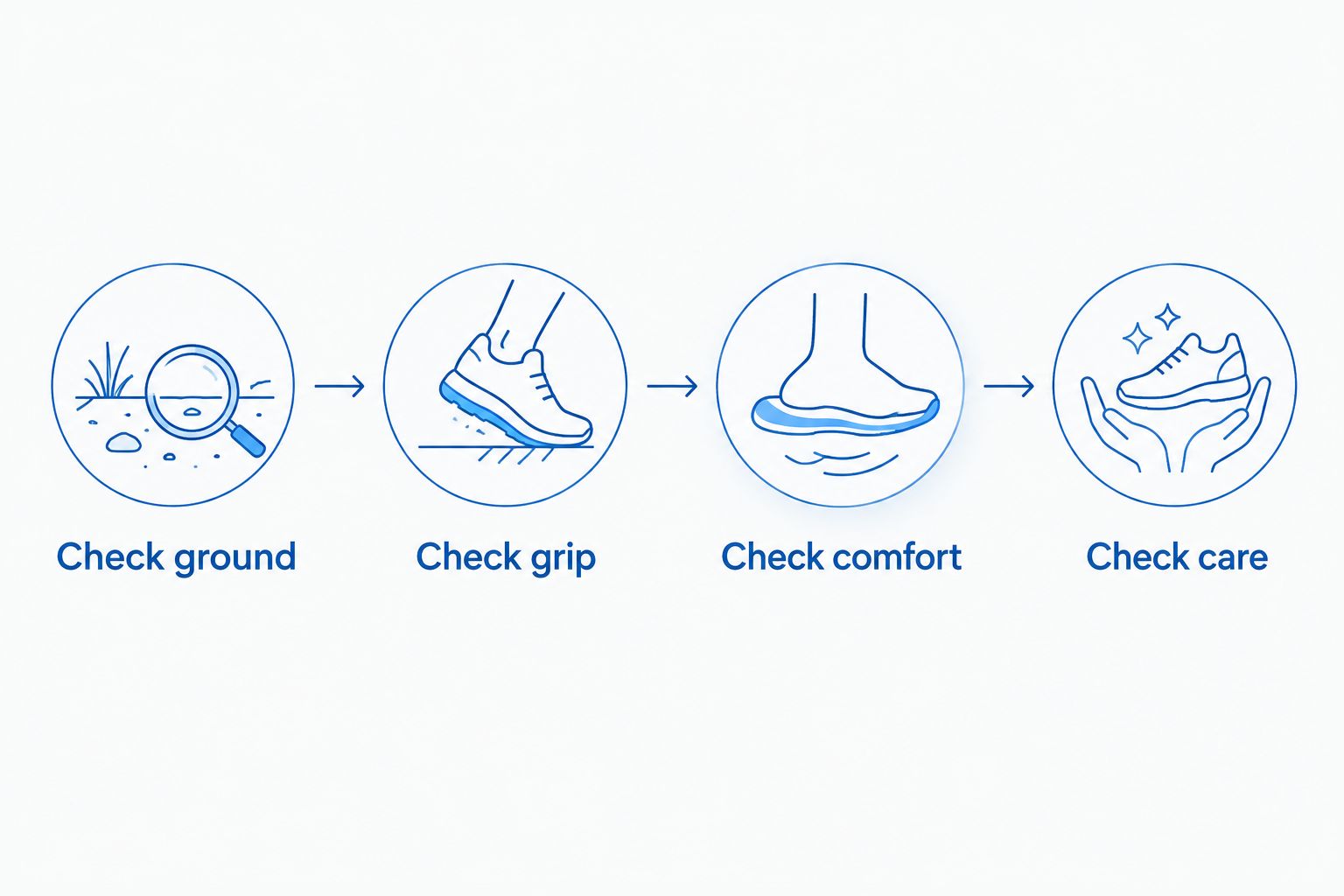
Keep your first outing focused on assessment. After 1 outdoor session, inspect the underside and edges before packing the mat away. This is a practical check for your chosen location, not a durability test or a promise of future performance.
Keep apparel and mat decisions separate
Silvers Sports Mess's supplied listings include sports bras and yoga apparel, but clothing fit and mat suitability answer different questions. Choose clothing that lets you move through your intended positions without constant adjustment. Assess the mat's traction separately.
A sports bra's neckline or fabric description does not establish the right support for every activity. If your outdoor routine includes running or jumping as well as yoga, use the sports bras for high-impact workouts guide as a separate buying decision.
For a 2026 outdoor kit, prioritize the mat and practice location before adding accessories. Silvers Sports Mess belongs in the complementary sports-merchandise decision, not in an unsupported ranking of yoga-mat manufacturers.
How we ranked these mat formats
The order follows mixed-practice suitability first, then distinct needs: carrying, floor comfort, surface preference, and reuse. It is a decision framework based on the criteria above, not a laboratory-tested product leaderboard.
Specific listings must still establish dimensions, construction, care requirements, and relevant grip claims. No named mat receives a performance score or an outdoor-use guarantee here.
Which outdoor yoga mat should you choose?
Choose a firm, textured yoga mat for a mixed outdoor yoga routine on flat, clean ground. That is the default decision for 2026, provided the individual mat passes your grip and care checks.
Choose a foldable travel mat when packed size determines whether you can bring it. Choose cushioning when floor comfort dominates your routine. If your existing mat already meets those needs, keep using it rather than replacing it without a reason.
FAQ
What's the best yoga mat for outdoor training?
A firm, textured yoga mat is the default choice for mixed outdoor yoga on flat, clean ground. Choose the individual mat by its two-sided grip, firmness, dimensions, and care instructions.
Is a thick yoga mat better for outdoor workouts?
A thick mat is not automatically better for outdoor workouts. Prioritize cushioning for floor-based exercises, but check whether compressible padding interferes with your standing balance.
Can I use a regular yoga mat outside?
Use a regular yoga mat outside only when its care instructions and condition suit the intended location. Check the ground, traction, and cleanup requirements before beginning your routine.
What's the best yoga mat for practicing on grass?
Choose a mat only after finding flat, cleared grass that provides a suitable practice surface. A mat cannot correct hidden holes, slopes, or unstable footing.
Is a cork yoga mat better than a travel mat outdoors?
Cork and travel describe different buying priorities, so neither is automatically better outdoors. Cork describes a contact surface; travel describes a carrying format that still needs appropriate grip and comfort.
How do I clean a yoga mat after an outdoor workout?
Follow the cleaning and drying instructions for the specific mat. Do not assume that soaking, machine washing, or direct-sun drying is permitted because the surface looks washable.
Should I buy a separate mat for outdoor yoga in 2026?
Buy a separate outdoor mat only when your existing mat fails a specific requirement such as grip, carrying size, comfort, or care compatibility. Evaluate your current equipment before choosing a replacement.
One last thing
The underside deserves as much attention as the surface you touch. A comfortable top is not enough when the mat moves against the ground. Before every outdoor session, check both interfaces: you against the mat, and the mat against the location.