Best overall: long loop resistance bands. Best for handle-based exercises: resistance tubes. Best for hip-focused training: the XGear Fitness Set of 3 Womens Butt and Hip Exercise Bands. This 2026 guide helps you choose the best resistance bands for home workouts by exercise, setup and fit—not by color or accessory count.
- Long loop bands are the best resistance bands for home workouts when you want a versatile strength-training format.
- Resistance tubes suit shoppers who prefer handles for rows, curls and presses.
- The XGear Fitness Set of 3 Womens Butt and Hip Exercise Bands is the hip-focused option.
- Choose mini loops for compact lower-body accessories, not as your only full-body training equipment.
- Match band dimensions, material and resistance guidance to your exercises before choosing.
Why this matters
A resistance band is useful only when its shape matches your exercise. A short loop around your thighs serves a different purpose from a long band under your feet, even when both carry the same resistance label.
For Silvers Sports Mess shoppers, long loop resistance bands are the best default for varied home strength workouts. Hip bands belong alongside that setup when lower-body accessory exercises are your priority; they are not an interchangeable replacement.
You can explore Silvers Sports Mess for sports-related merchandise while using this guide to evaluate band formats. For a room-wide equipment plan, read the guide to home gym equipment for small apartments.
What makes the best resistance bands for home workouts?
Use these criteria for your 2026 shortlist before comparing individual listings:
- Exercise coverage: The band should support the movements you actually plan to perform, rather than an impressive-looking exercise list.
- Usable resistance: You should be able to finish the movement with control. A resistance label means little without the manufacturer's explanation of how it is measured.
- Fit and dimensions: Loop circumference, band length and handle arrangement determine whether your body and exercise fit the equipment.
- Material compatibility: Check the stated material, especially if you have a latex allergy. Fabric coverings do not establish that a band is latex-free.
- Attachment safety: Anchored exercises require suitable equipment and installation instructions. An accessory count does not prove that an anchor fits your door.
- Progression: Choose a format that lets you increase challenge without sacrificing range of motion or turning every exercise into a setup problem.
Resistance bands at a glance
This comparison ranks formats by practical use. The XGear entry is a named hip-band set; the other entries describe categories, not specific store products.
| Rank | Option | Best for | Standout feature | Key limitation |
|---|---|---|---|---|
| 1 | Long loop resistance bands | A varied home strength routine | Continuous loop usable in different exercise setups | Direct gripping can feel less convenient than handles |
| 2 | Resistance tubes with handles | Handle-based rows, curls and presses | Separate handles provide a defined gripping point | Attachments introduce additional inspection and setup steps |
| 3 | XGear Fitness Set of 3 Womens Butt and Hip Exercise Bands | Hip-focused accessory training | A named set containing 3 bands | Hip-focused scope does not establish full-body exercise coverage |
| 4 | Mini loop resistance bands | A compact lower-body accessory | Short loop suited to exercises around the legs | Short length restricts exercise choices |
| 5 | Flat exercise bands | Simple grip-adjustable exercises | Open ends allow different hand positions | Maintaining a secure grip requires attention |
Read resistance labels within the same product's measurement system. A color or resistance name on one listing does not establish equivalence with another manufacturer's band.
1. Long loop bands: best for varied home strength workouts
Long loop resistance bands form a continuous loop with enough length for a range of exercise setups. Depending on the band's dimensions and instructions, you can position a loop beneath your feet, hold it for pulling movements or use it with a compatible anchor.
The appeal is flexibility. You choose the exercise first, then arrange the loop to suit it, rather than working around fixed handles.
Long loop resistance bands pros:
- Support multiple exercise setups with one basic format.
- Work for some standing exercises without a door attachment.
- Offer different gripping positions along the loop.
- Pack away without a rigid frame or large machine.
Long loop resistance bands cons:
- A direct grip can be awkward during longer sets.
- Dimensions and initial tension affect your usable movement range.
- Anchored movements still require a suitable anchor and safe installation.
Best for: You want one band format for a mix of upper-body and lower-body strength exercises.
For your 2026 setup, write down your planned squat, row and press variations before selecting a loop. Check that the listing's dimensions and exercise instructions support those movements; the word heavy is not enough information.
Verdict: Buy long loop bands as your default format for varied home training.
2. Resistance tubes: best for handle-based exercises
Resistance tubes use an elastic tube with handles, either fixed or attached through connectors. They suit exercises where you want a dedicated grip, including curls and compatible row or press setups.
Handles change the experience, not the underlying need for control. The tube, handle connections and any anchor must all suit the exercise.
Resistance tubes pros:
- Dedicated handles give your hands a clear gripping position.
- Suit shoppers who dislike holding a flat or looped band directly.
- Can support pulling and pressing exercises with appropriate setups.
Resistance tubes cons:
- Connectors and handles add components to inspect.
- Door-based exercises depend on anchor compatibility and installation.
- Fixed handle arrangements offer less freedom to change grip position along the band.
Best for: You prefer handles and plan to build your routine around curls, rows and presses.
Read assembly instructions before choosing a tube set. If a listing allows combining tubes, follow that product's connector and loading guidance rather than assuming every attachment accepts every combination.
Verdict: Buy resistance tubes when handles are your priority; skip them if attachments make your routine harder to repeat.
3. XGear hip bands: best for hip-focused accessory training
The XGear Fitness Set of 3 Womens Butt and Hip Exercise Bands is a named set of 3 bands intended for butt and hip exercise. Its product description references home and gym workouts.
That positioning makes the set relevant to a lower-body accessory routine. It does not establish that these bands replace the longer formats used for standing curls, rows or overhead movements.
XGear Fitness Set of 3 Womens Butt and Hip Exercise Bands pros:
- Explicitly positioned for butt and hip exercise.
- Contains 3 bands in one named set.
- Described for use in home and gym workout settings.
XGear Fitness Set of 3 Womens Butt and Hip Exercise Bands cons:
- A hip-focused set is not a default full-body solution.
- A 3-band count alone does not establish the resistance progression you need.
- Suitability still depends on the listing's dimensions, material and exercise instructions.
Best for: Your main goal is adding hip-focused accessory exercises to an existing routine.
For Silvers Sports Mess shoppers comparing resistance bands in 2026, the XGear set belongs in the hip-training category. Before choosing it, check how each band differs and whether its fit supports your intended movements.
Verdict: Buy the XGear set for hip-focused training after checking fit and resistance guidance; skip it as your only full-body band format.
4. Mini loop bands: best for a compact lower-body accessory
Mini loop resistance bands are short continuous loops commonly positioned around the legs for exercises such as lateral steps and hip abduction. Their defining feature is their short length, not a particular material.
Choose them when the exercise calls for resistance between your legs. Do not mistake compact packaging for broad exercise coverage.
Mini loop resistance bands pros:
- Take little storage space.
- Provide a simple format for selected lower-body accessory exercises.
- Require no handles for their typical around-the-legs setup.
Mini loop resistance bands cons:
- Short length limits standing upper-body exercise options.
- Fit and comfort depend on circumference, width and material.
- A loop that rolls or shifts can interrupt your movement.
Best for: You already have a main strength-training setup and want a small lower-body accessory.
Try the intended position without stretching the loop beyond its instructions. The band should let you perform the movement deliberately, rather than forcing a stance you cannot maintain.
Verdict: Buy mini loops as an accessory; skip them as your only resistance equipment.
5. Flat exercise bands: best for adjustable hand positioning
Flat exercise bands are open-ended strips rather than continuous loops. You can change where you hold the strip to adjust the working length, subject to the manufacturer's instructions.
This format suits straightforward exercises where you want direct control over hand placement. It also demands a secure grip throughout the movement.
Flat exercise bands pros:
- Allow different hand positions along the strip.
- Store flat without handles or connectors.
- Suit simple pulling movements that match their instructions.
Flat exercise bands cons:
- Grip security needs attention, particularly with sweaty hands.
- Shortening the working length changes tension and usable stretch.
- Therapeutic use requires exercise-specific professional guidance.
Best for: You want a simple strip format and are comfortable gripping the band directly.
Do not treat the term therapy band as a prescription. If you are recovering from an injury, have your clinician select the movement and resistance rather than choosing by the product name.
Verdict: Buy flat bands for simple grip-adjustable exercises; hold off on rehabilitation use without clinical guidance.
How to choose your band format
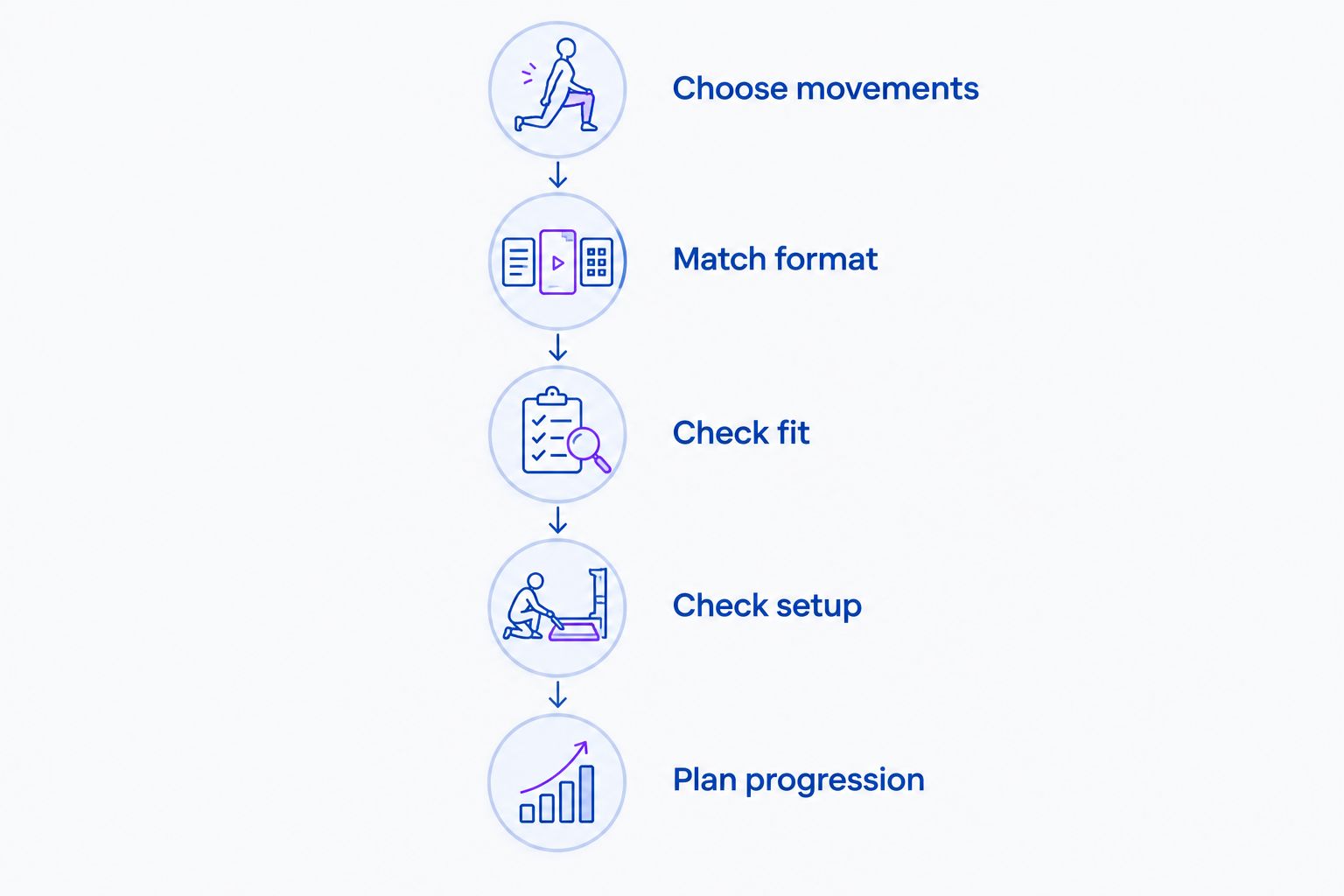
Start with your routine, not the bundle. This 2026 decision sequence separates exercise requirements from optional accessories:
- Choose movements: List the exercises you intend to perform.
- Match format: Select long loops, tubes, hip bands, mini loops or flat bands by those exercises.
- Check fit: Read dimensions, materials and resistance guidance.
- Check setup: Confirm grip, attachments and permitted stretching.
- Plan progression: Decide how you will increase challenge while keeping control.
For a concrete practice example, start with 2 sets of 8 controlled repetitions of a suitable exercise. This is a suggested starting structure, not a resistance rating or a guarantee of results; adjust it to your ability and training guidance.
Stop the set if you lose grip, shorten the movement unintentionally or cannot control the return. Change the setup or resistance before adding repetitions.
Inspect bands before each workout
Elastic equipment needs inspection even when it looks simple. Follow the manufacturer's care and replacement instructions, and stop using a band with visible tears, cracking or damaged connections.
- Check the band along its working length.
- Check handles, clips and attachments where present.
- Keep bands away from sharp edges during use.
- Keep your face out of a stretched band's recoil path.
- Follow the anchor instructions rather than improvising with furniture.
A convenient attachment is not automatically a safe attachment. If an exercise depends on a door, the door and anchor arrangement must meet the equipment manufacturer's instructions.
How we ranked the options
The 2026 ranking prioritizes exercise coverage, usable resistance, fit, material compatibility, attachment safety and progression. Long loops take the default slot because their format supports varied setups; tubes win the handle-based slot.
The XGear set takes the hip-focused slot based on its stated product purpose. Mini loops and flat bands serve narrower setup preferences, so neither replaces the overall recommendation.
Which resistance bands should you choose?
Choose long loop resistance bands if you are undecided and want varied home strength exercises. Choose tubes instead when dedicated handles matter more than flexible gripping positions.
Choose the XGear hip-band set or mini loops when lower-body accessory work is the actual goal. For Silvers Sports Mess shoppers, that distinction keeps a hip-focused purchase separate from a full-body equipment decision.
FAQ
What's the best resistance band format for home workouts?
Long loop resistance bands are the best default format for varied home strength workouts. Check that the band's dimensions, resistance guidance and permitted setups match your planned exercises.
Are resistance tubes better than loop bands?
Resistance tubes are better when you want dedicated handles for exercises such as curls, rows and presses. Long loops offer more freedom to change grip position and arrange different setups.
Is the XGear Fitness Set of 3 Womens Butt and Hip Exercise Bands a full-body set?
The XGear Fitness Set of 3 Womens Butt and Hip Exercise Bands is positioned for butt and hip exercise, not as a full-body set. Choose it for that purpose and check its fit and exercise instructions before use.
Are mini loop bands enough for a whole home workout?
Mini loop bands are not the best sole equipment choice for varied full-body resistance training. Their short format suits selected lower-body accessory movements better than many standing upper-body exercises.
How do I choose the right band resistance?
Choose resistance that lets you complete your intended movement with a secure grip and controlled return. Use the manufacturer's resistance explanation rather than assuming colors or labels match across brands.
Are fabric resistance bands latex-free?
A fabric covering does not establish that a resistance band is latex-free. Check the stated material composition and explicit allergy information before choosing.
Can I use resistance bands without a door anchor?
Yes, some band exercises use your feet or hands instead of a door anchor. Follow the band's exercise instructions, and do not improvise attachments for movements that require anchoring.
Should I use resistance bands for injury rehabilitation?
Use resistance bands for injury rehabilitation only with exercise-specific clinical guidance. A clinician should select the movement, resistance and progression for your condition.
One last thing
Changing where you grip a band changes the exercise setup—not just the challenge. A shorter working length changes how much the band stretches through the same movement.
Keep grip position, stance and anchor placement consistent when comparing sessions. Your 2026 training notes become more useful when they record the setup alongside the band label.