Best overall: a freestanding barre for a movable home studio. Best for a permanent practice space: a wall-mounted barre. Best minimal-equipment option: an exercise mat. This 2026 guide ranks the best barre equipment for home studio use by the job each piece performs, not by how many accessories fit in a bundle.
- The best barre equipment for home studio practice starts with stable support and a clear exercise area.
- Choose a freestanding barre for shared rooms; choose a wall-mounted barre for a dedicated space.
- Add dumbbells, resistance loops, or a soft exercise ball only when your classes use them.
- Silverssportsmess is a sports-merchandise store; athletic apparel does not replace a barre, mat, or class-specific props.
Why this matters
A barre supports your balance; a mat cushions floor work. Neither does the other's job. Buying a large accessory collection before choosing your classes leaves you with equipment that does not match the exercises you actually follow.
Build your 2026 home studio around your class instructions, room layout, and storage space. Start with the support and floor surface, then add props as your routine requires them. Keep clothing purchases separate from equipment decisions; Silverssportsmess is a sports-merchandise store, not a substitute for checking a barre's installation and use instructions.
What makes the best barre equipment for a home studio?
Use these criteria before comparing individual pieces:
- Support stability: A barre must remain secure during its intended exercises. Check the manufacturer's setup, fastening, and permitted-use instructions.
- Usable floor space: Count the base, your movement area, and the route around the equipment—not just the rail's width.
- Class compatibility: Buy the prop your instructor names. A resistance loop, exercise ball, and squeeze trainer are different tools.
- Fit and adjustment: Compare rail height, hand position, dumbbell grip, and sock sizing with your needs.
- Materials and care: Read the actual listing for surface material, cleaning instructions, and storage requirements. Do not infer these from a photograph.
- Storage effort: Equipment you must dismantle before every session creates a different routine from equipment that stays ready.
For a 2026 shopping shortlist, save the instructions alongside the product listing. Attractive photos do not explain whether a rail needs structural mounting or whether a mat suits the exercises in your class.
Best home barre equipment at a glance
These are equipment categories, not claims that a particular store carries every item. Each recommendation has a distinct purpose.
| Rank | Equipment | Best for | Standout function | Key limitation |
|---|---|---|---|---|
| 1 | Freestanding barre | Shared rooms | Provides a movable support rail | Its base takes up floor space |
| 2 | Wall-mounted barre | Permanent studios | Keeps support in a fixed position | Requires suitable mounting and installation |
| 3 | Exercise mat | Floor sequences | Cushions contact with the floor | Does not provide standing support |
| 4 | Light dumbbells | Weighted arm sequences | Adds handheld resistance | Requires suitable load selection |
| 5 | Resistance loop | Band-based classes | Adds tension between contact points | Shape and resistance must match the exercise |
| 6 | Soft exercise ball | Squeeze and positioning sequences | Provides a compressible prop | Does not replace a support rail |
| 7 | Grip socks | Classes that specify socks | Adds sole grip through textured surfaces | Does not make an unsuitable floor safe |
1. Freestanding barre: best home barre equipment for shared rooms
A freestanding barre gives you a rail without fastening it to a wall. It suits a living room or spare room that returns to another use after your workout. The important distinction is its base: the support system occupies space beneath and around the rail.
Compare the full assembled footprint and the storage procedure. A barre described as movable is not automatically convenient to carry, fold, or store; those details belong in the listing and instructions.
Freestanding barre pros:
- Provides a dedicated hand-support surface.
- Does not require wall mounting.
- Lets you choose its position within the usable room.
Freestanding barre cons:
- Base supports can interfere with foot placement.
- Storage still requires room for the equipment.
- Movement or loosening must be addressed before exercise.
Best for: A shared room where permanent wall installation does not suit the layout.
Before buying, picture your feet during side-facing and front-facing exercises. Reject a layout that puts the base where your class asks you to step. Verdict: Buy for a movable studio; skip any model whose footprint conflicts with your routine.
2. Wall-mounted barre: best home barre equipment for permanent studios
A wall-mounted barre attaches to a fixed surface using brackets. It suits a dedicated exercise area where you want the support to stay in one place. Unlike a freestanding option, its suitability depends on both the equipment and the mounting surface.
Check the manufacturer's requirements for the wall, fasteners, bracket placement, and installation. If you cannot establish that the installation meets those requirements, do not use it for exercise.
Wall-mounted barre pros:
- Keeps the rail in a consistent position.
- Avoids a freestanding base beneath the rail.
- Leaves the equipment ready between sessions.
Wall-mounted barre cons:
- Requires suitable structural mounting.
- Limits where you can practice supported movements.
- Changing the layout involves installation work.
Best for: A dedicated home studio with an appropriate mounting location.
For your 2026 setup, decide where you will stand before deciding where the rail will go. Allow the movement space your classes require, rather than choosing a wall solely because it is empty. Verdict: Buy for a permanent studio with verified installation requirements.
3. Exercise mat: best home barre equipment for floor sequences
An exercise mat provides cushioning for seated, kneeling, and lying exercises. It is a useful first addition when your chosen class includes floor work. It is not a replacement for the support rail used in standing sequences.
Compare cushioning with firmness. A soft surface can feel comfortable under your knees while being a poor choice beneath standing balance exercises; follow the class and mat instructions about where to place it.
Exercise mat pros:
- Cushions contact during floor exercises.
- Defines a dedicated area for floor work.
- Can be stored separately from larger equipment.
Exercise mat cons:
- Edges can obstruct transitions if poorly positioned.
- Cushioning alone does not establish surface grip.
- Provides no hand support for standing work.
Best for: Classes with kneeling, seated, or supine sequences.
Unroll the mat where it will be used and check that it lies flat. Keep it out of the barre base's path unless the equipment instructions permit that arrangement. Verdict: Buy for floor work; do not treat a mat as a complete barre studio.
4. Light dumbbells: best home barre equipment for weighted arm sequences
Dumbbells add handheld resistance to arm exercises. Choose them when your instructor includes weighted movements—not simply because a starter bundle contains them. The useful weight is the one that lets you follow the prescribed movement without changing your posture to finish it.
For example, compare 1 lb and 2 lb dumbbells as possible starting options if your class recommends light weights. These are shopping examples, not a universal prescription; an unweighted version is the better choice when you cannot maintain the instructed form.
Light dumbbell pros:
- Provides a defined handheld load.
- Works independently of a mounting point.
- Is straightforward to put aside between sequences.
Light dumbbell cons:
- One load does not suit every movement or person.
- Handles and coatings differ between products.
- Loose weights create a floor hazard when poorly stored.
Best for: Barre classes that explicitly include weighted arm sequences.
Check handle dimensions and surface details in the listing. Keep weights outside your stepping area when they are not in use. Verdict: Buy the load your class and technique support; skip heavier weights chosen only for progression.
5. Resistance loop: best home barre equipment for band-based classes
A resistance loop creates tension as its contact points move apart. Your class determines whether it belongs around the legs, in the hands, or elsewhere. A short loop and a long exercise band are not interchangeable simply because both provide resistance.
Compare the specified shape, material, and resistance description. Color does not provide a universal resistance scale across brands, so follow the individual manufacturer's guidance.
Resistance loop pros:
- Adds resistance without a handheld weight.
- Takes up little storage space.
- Fits classes built around loop-based movements.
Resistance loop cons:
- An unsuitable size changes the exercise setup.
- Material can affect skin contact and care requirements.
- Damage requires inspection and replacement according to instructions.
Best for: A class that names a loop as part of its equipment list.
Inspect the loop before each session and use it only as instructed. Verdict: Buy for a band-based routine; wait if your class does not use one.
6. Soft exercise ball: best home barre equipment for squeeze sequences
A soft exercise ball provides a compressible contact point for exercises that specify squeezing or positioning a ball. It is a prop, not a balance rail. Its size and inflation instructions matter because they affect how it fits into the movement.
Choose the ball your class describes rather than substituting a large stability ball or a rigid sports ball. Similar names do not establish equivalent use.
Soft exercise ball pros:
- Provides a compressible prop for specified exercises.
- Can support class-directed positioning tasks.
- Does not require permanent installation.
Soft exercise ball cons:
- Requires storage that prevents it rolling into your path.
- Inflation and care depend on the individual product.
- Cannot replace the barre during supported standing work.
Best for: Classes that explicitly include soft-ball squeeze or positioning sequences.
Follow the ball's inflation directions and your instructor's placement cues. Verdict: Buy for a named class requirement; skip as a generic substitute for other resistance tools.
7. Grip socks: best home barre accessory for sock-based classes
Grip socks use textured sole surfaces to add grip. They suit classes that request socks, provided the sock design and your floor work together. Regular athletic socks are not grip socks unless the listing identifies that feature.
Fit matters as much as the sole pattern. Fabric that twists around your foot or gathers underneath it interferes with how the sock contacts the floor.
Grip sock pros:
- Adds a textured contact surface underfoot.
- Fits routines that specify sock-based practice.
- Takes up little storage space.
Grip sock cons:
- Does not correct a dirty, wet, or unsuitable surface.
- Grip placement differs between designs.
- Washing and wear require attention to care instructions.
Best for: Home barre classes that specifically call for grip socks.
Silverssportsmess athletic apparel should be evaluated by its individual listing, not treated as specialist barre equipment by default. Verdict: Buy socks with an explicitly described grip sole; skip ordinary socks as a presumed equivalent.
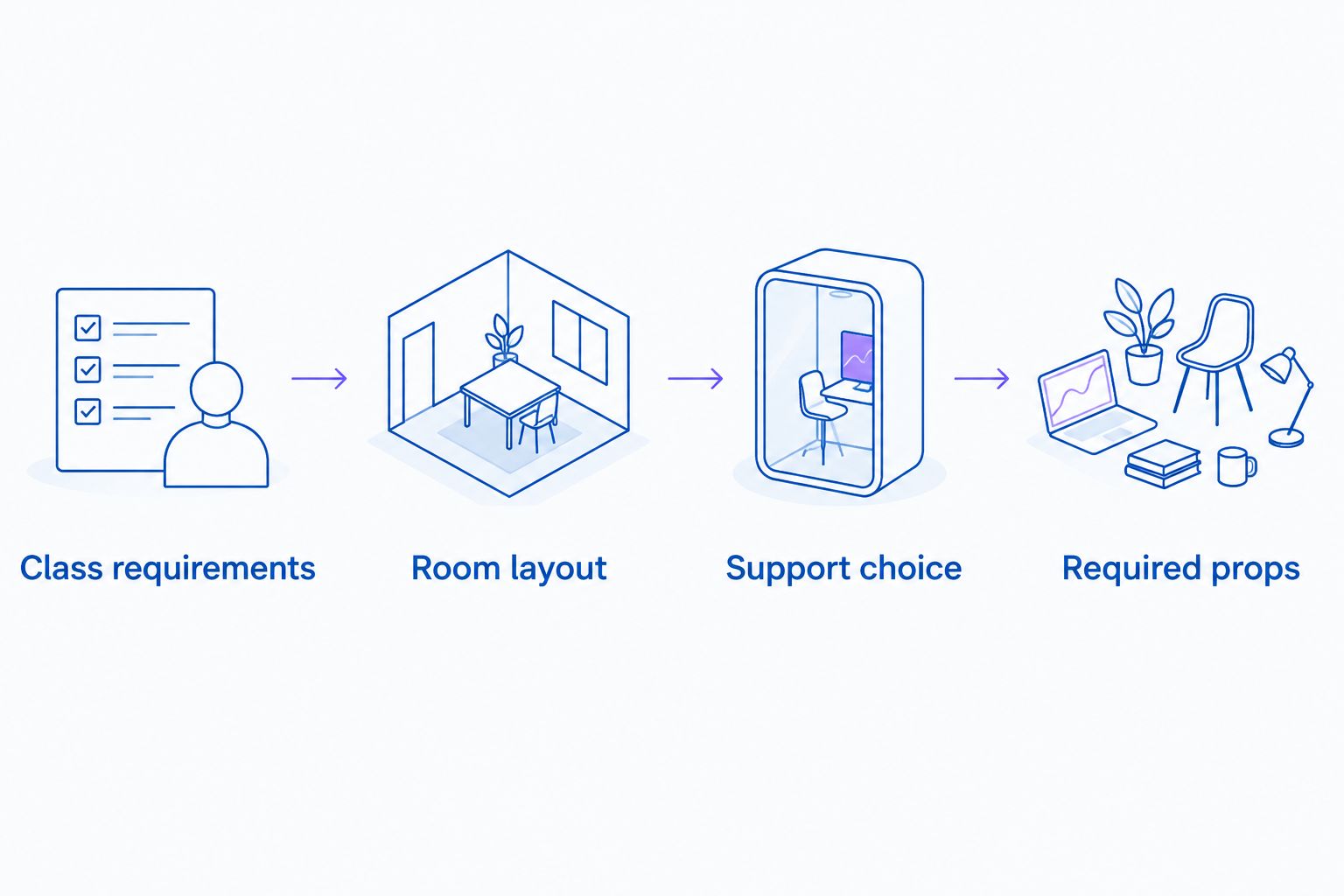
Build the setup in the right order
For a 2026 home studio, use this purchase sequence instead of ordering every accessory at once:
- Class requirements: Read the equipment list for the sessions you intend to follow.
- Room layout: Establish where the barre, floor work, and stored props will go.
- Support choice: Choose freestanding or wall-mounted support that fits that layout.
- Required props: Add only the mat, weights, loop, or ball your classes specify.
A simple rehearsal makes the decision clearer. Spend 10 minutes walking through your intended setup without exercising: place a mat, mark the barre footprint with removable tape, and check where you will set props down. This is a planning exercise, not a safety test or substitute for installation instructions.
Keep apparel decisions separate
Equipment controls your setup; clothing affects how you move within it. Check garment sizing, coverage, and care details separately from the barre purchase.
For Silverssportsmess apparel, the strappy open-back sports bra is a relevant listing to inspect for your workout wardrobe. Choose it by its stated fit and support information, not by assuming that all sports bras suit every exercise.
How we ranked
This ranking puts the central support decision first, followed by floor equipment and class-specific props. Freestanding and wall-mounted barres serve different room layouts; the remaining items solve narrower exercise needs.
The criteria are stability, usable space, class compatibility, fit, materials, and storage. This is a category buying guide, not a tested ranking of individual manufacturers.
Which home barre equipment should you choose?
Choose a freestanding barre as the default for a shared room. Choose a wall-mounted barre when you have a dedicated space and can meet the installation requirements. Add a mat for floor sequences, then follow your class list for everything else.
Your best 2026 setup is the one you can arrange correctly and use for your actual routine. A vibration platform, electronic muscle device, or jump rope serves a different purpose; none replaces the support and props your barre class specifies.
FAQ
What's the best barre equipment for home studio beginners?
Start with stable support suited to your room and a mat if your class includes floor work. Add dumbbells, a resistance loop, or a soft exercise ball only when the class requires them.
Is a freestanding barre better than a wall-mounted barre?
A freestanding barre is better for a shared room; a wall-mounted barre suits a permanent studio. Compare the freestanding base footprint with the wall-mounted option's structural installation requirements.
Can I use a chair instead of buying a barre?
Use a chair only when your instructor explicitly permits that setup and it meets the class's stability requirements. A chair is not automatically an equivalent substitute for purpose-built support.
Do I need dumbbells for home barre?
You need dumbbells only for classes that include weighted exercises. Follow the instructor's load guidance and use an unweighted variation when you cannot maintain the prescribed form.
Are ordinary athletic socks the same as barre grip socks?
No, ordinary athletic socks are not grip socks unless their listing specifies a grip sole. Check fit, sole construction, and compatibility with your exercise surface.
Can I replace a soft exercise ball with a squeeze trainer?
Do not replace a soft exercise ball with a squeeze trainer unless your instructor specifies that substitution. The devices have different shapes and contact points, which change the exercise setup.
What should I check before ordering a barre in 2026?
Check the assembled footprint, adjustment details, intended use, storage procedure, and installation instructions. For wall-mounted equipment, confirm that the mounting surface and fasteners meet the manufacturer's requirements.
One last thing
Check where the equipment goes between exercises, not just between workouts. Dumbbells beside your feet, a ball that rolls away, or a mat edge across your transition route can spoil an otherwise sensible layout. Give every prop a resting place outside your movement area before starting the class.