Best overall: an exercise mat for floor work. Best for standing practice: a stable barre or suitable support. Best no-extra-equipment option: a sturdy chair you already own, if your instructor approves it. The best barre fitness equipment for beginners in 2026 matches your class plan; grip socks, bands, balls, and weights belong on the list only when the exercises call for them.
- An exercise mat is the best first purchase for beginner barre workouts that include floor exercises.
- A stable support comes before resistance bands or weights when your barre class includes supported standing exercises.
- Silvers Sports Mess exercise bands and indoor fitness ball are optional accessories; match them to your instructor’s requirements.
- Grip socks are not interchangeable with ordinary athletic socks; check your studio’s footwear rules.
Why this matters
Barre equipment has different jobs. A support assists standing practice, a mat provides a surface for floor exercises, and resistance accessories change an exercise rather than replace its foundation.
For beginners shopping Silvers Sports Mess for barre fitness equipment, exercise bands are an optional add-on, not the starting point. Choose the class first, then buy the equipment it actually uses. A Pilates ball, hip band, or pair of dumbbells is not essential simply because it appears in a fitness catalog.
This 2026 guide ranks equipment categories by their role in a beginner session. The recommendations distinguish between general buying criteria and specific products whose names and descriptions identify their intended use.
What makes the best beginner barre equipment?
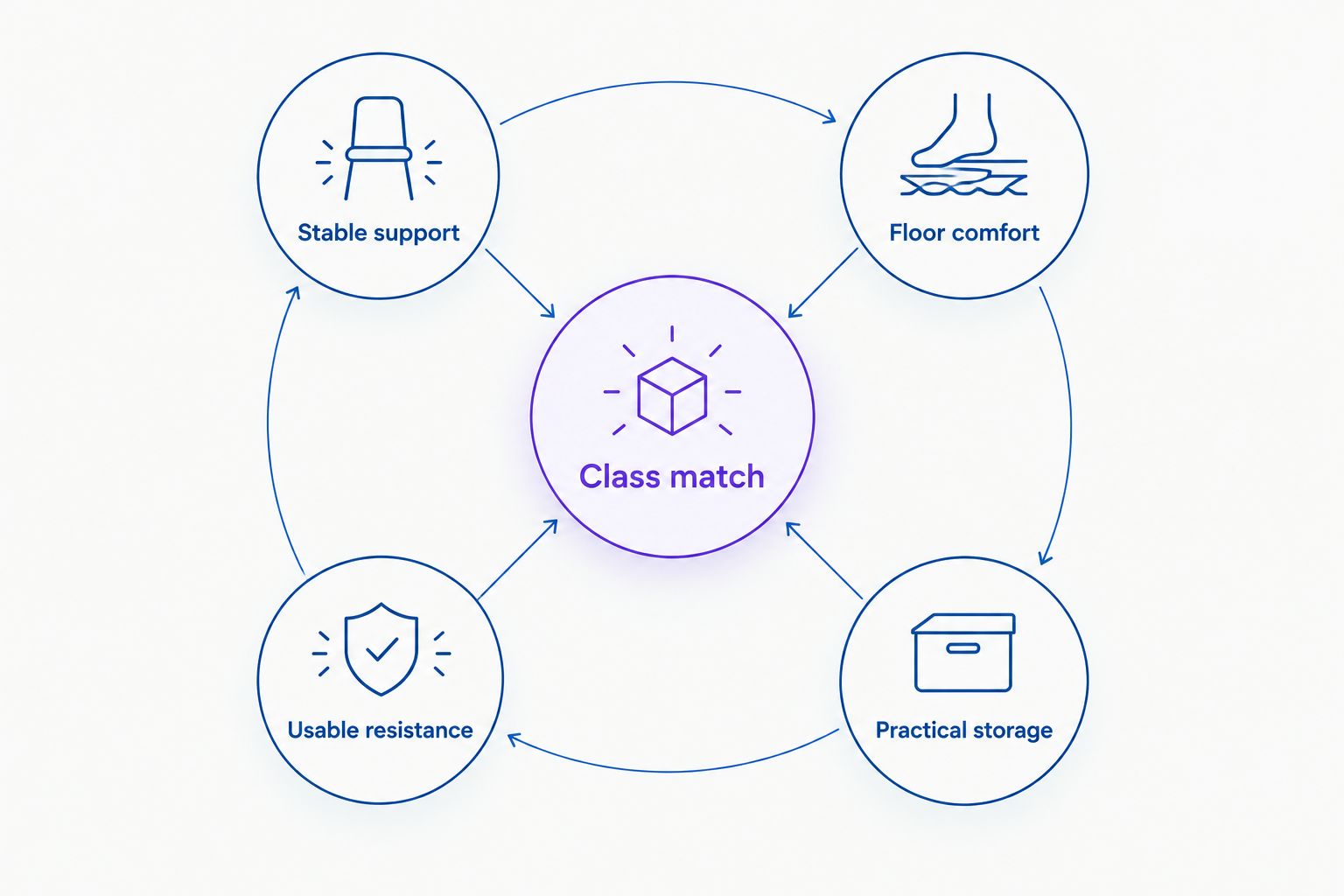
Judge each purchase against these criteria before choosing a brand or bundle:
- Class match: Buy the prop your instructor specifies, not a similar-looking substitute. Loop bands, long bands, and different ball sizes serve different exercises.
- Stable support: A standing support must suit the movement without rolling, sliding, or tipping. Follow the equipment instructions and your instructor’s setup guidance.
- Floor comfort: A mat should suit kneeling, seated, and lying exercises without creating an unnecessarily unstable standing surface.
- Usable resistance: Choose resistance you can control through the instructed movement. Greater resistance is not automatically the better beginner choice.
- Practical storage: Check where each item will live between sessions. A dedicated barre needs different storage planning from a mat or band.
These criteria make the shopping order straightforward: establish the support and floor setup, confirm footwear, then add class-specific resistance. Clothing belongs in a separate fit decision rather than an equipment bundle.
Beginner barre equipment at a glance
| Rank | Equipment | Best for | Standout role | Key limitation |
|---|---|---|---|---|
| 1 | Exercise mat | Floor-based beginner routines | Provides a dedicated surface for kneeling and lying exercises | Does not replace a standing support |
| 2 | Stable barre or suitable support | Supported standing practice | Gives you a consistent place for light hand support | Needs a setup appropriate to the exercise |
| 3 | Grip socks | Studios that require grip footwear | Adds a grip sole rather than ordinary sock fabric underfoot | Fit and floor compatibility still matter |
| 4 | Resistance bands | Instructor-led resistance sequences | Adds resistance without a large machine | Band shape and resistance must match the class |
| 5 | Small exercise ball | Classes using ball squeezes or positioning cues | Provides a prop for specific instructed exercises | A generic fitness ball is not automatically the right size |
| 6 | Light dumbbells | Classes with weighted arm sequences | Adds external load to hand-held exercises | Unnecessary when the beginner program uses no weights |
1. Exercise mat: best barre equipment for floor-based routines
An exercise mat gives you a dedicated surface for kneeling, sitting, and lying exercises. It earns the first position because it serves a clear role without adding resistance or asking you to learn another piece of equipment.
Best for: beginners whose barre classes include floor work. Check the class format before ordering: a standing-only session does not create the same need. For your 2026 setup, compare the mat’s stated dimensions, material, cleaning instructions, and intended use rather than choosing by appearance alone.
Exercise mat pros:
- Gives floor exercises a defined practice area.
- Separates your workout surface from the surrounding floor.
- Works independently of bands, balls, or weights.
- Can be selected around your actual storage space.
Exercise mat cons:
- Does not provide support for standing balance exercises.
- A soft or shifting surface is unsuitable for some standing movements.
- Requires cleaning and a place to dry or store it.
Before buying, check whether the routine keeps the mat under you for standing work or uses it only for the floor section. Do not assume that more cushioning improves every part of a barre session.
Verdict: Buy if your beginner routine includes floor exercises; skip for a standing-only class that supplies everything you need.
2. Stable barre or suitable support: best for standing practice
A barre provides a hand-support point during instructed standing exercises. At home, a suitable stationary support can serve that role when the instructor allows the substitution.
Best for: beginners following supported standing barre routines. Decide whether you need a dedicated barre after checking the movements your program teaches. A support for light contact is not permission to hang your body weight from furniture.
Stable support pros:
- Provides a consistent hand position for supported exercises.
- Lets you follow routines designed around a barre.
- Keeps the equipment choice tied to a clear movement requirement.
- An approved existing support avoids adding another object to the room.
Stable support cons:
- Furniture can slide, tip, or be unsuitable for the movement.
- A dedicated barre requires setup and storage space.
- A support at the wrong height can make positioning awkward.
Avoid rolling chairs and supports that move when you touch them. Check the support on the actual floor where you will exercise, not just in its usual location. If the setup changes your posture or requires a tight grip to feel secure, ask the instructor for a different arrangement.
Verdict: Buy a dedicated barre only when your class needs one and your existing support is unsuitable.
3. Grip socks: best for studios with footwear requirements
Grip socks have grip material on the sole; ordinary athletic socks do not automatically provide that feature. Their place in a beginner kit depends on the studio’s rules and the floor you will use.
Best for: beginners attending classes that require grip socks. In 2026, check the actual product description for a grip sole rather than relying on words such as athletic, sport, or performance. Those labels do not establish suitability for barre.
Grip socks pros:
- Meet a specific equipment need when the studio requires them.
- Provide a footwear option distinct from ordinary socks.
- Take little room in a class bag.
Grip socks cons:
- A loose fit can let your foot move inside the sock.
- Grip soles do not correct an unstable support or poor positioning.
- Cleaning instructions differ between products.
Choose the listed size using the maker’s size guidance. Check whether the studio accepts the style before buying several pairs, and follow its rules about barefoot practice instead of treating socks as universally required.
Silvers Sports Mess athletic sock listings should not be treated as grip-sock recommendations unless their descriptions explicitly identify that feature. Waterproofing, cotton content, or a no-show cut answers a different shopping question.
Verdict: Buy when your studio requires grip socks; hold until you confirm the footwear policy otherwise.
4. Resistance bands: best for class-specific resistance sequences
Resistance bands add an external resistance source to exercises designed for them. A hip loop and a long exercise band are not interchangeable just because both stretch.
Best for: beginners whose instructor specifies a band-based sequence. Start with the required band type, then check resistance information, dimensions, and care instructions. Stop the comparison if a listing does not establish whether the band matches the exercise.
Resistance band pros:
- Adds resistance without requiring a large exercise machine.
- Fits routines that explicitly teach band placement and movement.
- Provides a separate purchase from a full home-gym setup.
- Can suit a compact kit when the product’s storage requirements allow it.
Resistance band cons:
- The wrong shape or resistance changes the intended exercise.
- Placement and control require instruction.
- Bands need inspection and care according to their instructions.
The XGear Fitness Set of 3 Womens Butt and Hip Exercise Bands is identified as a set of hip exercise bands. That makes it a candidate for a class asking for that equipment type, not proof that it suits every barre routine. Confirm the band format and resistance details before selecting it for class.
Verdict: Buy only after your instructor identifies the band type and suitable resistance.
5. Small exercise ball: best for instructed ball sequences
A small exercise ball serves as a prop in barre routines that specify ball placement or squeezing exercises. It is different from a large ball used for seated balance or other fitness work.
Best for: beginners following a class that names a small ball as required equipment. For a 2026 purchase, verify the intended diameter, inflation instructions, and exercise use. The phrase fitness ball alone does not answer those questions.
Small exercise ball pros:
- Supports routines specifically designed around a ball prop.
- Gives you a defined object for instructed placement cues.
- Adds a different exercise option from bands or hand-held weights.
Small exercise ball cons:
- Size matters for placement and the intended movement.
- A large fitness ball is not a direct substitute.
- Inflation and storage require attention to product instructions.
The Indoor Fitness Ball: Perfect for Pilates and Core Exercises is described for indoor Pilates and core work. Those stated uses make it relevant to compare, but they do not establish that it is the small ball your barre instructor requests. Confirm the dimensions before choosing it as a barre prop.
Verdict: Hold until the ball’s size and intended use match your class instructions.
Two accessories to compare after checking your class plan
Silvers Sports Mess has supplied listings for the hip-band set and indoor fitness ball below. Compare their detailed specifications with your instructor’s requirements; neither accessory replaces a suitable mat or standing support.


6. Light dumbbells: best for weighted arm sequences
Dumbbells add load to exercises performed with hand-held weights. They belong in a beginner barre setup only when the routine includes a weighted sequence and tells you how to select the load.
Best for: beginners taking classes with instructed weighted arm work. Learn the movement without weights when your instructor permits it. Then select weights that let you maintain the prescribed position rather than chase fatigue.
Light dumbbell pros:
- Provides the hand-held load required by weighted sequences.
- Keeps the equipment role easy to identify.
- Allows a separate equipment choice for arm work.
Light dumbbell cons:
- Adds load before you have necessarily learned the movement.
- Requires secure handling and safe storage.
- Serves no purpose in a routine that does not use weights.
Compare the handle, stated weight, and storage needs. Do not substitute weighted gloves or another wearable resistance product for dumbbells unless the instructor explicitly adapts the exercise for it.
Verdict: Wait until your class calls for dumbbells and you can perform the movement as instructed.
How the equipment is ranked
This ranking prioritizes class match, stable support, floor comfort, usable resistance, and practical storage. It ranks equipment roles, not measured performance between brands.
The mat leads for floor-based routines. Standing support leads for a standing-only program. Grip socks follow studio rules, while bands, balls, and dumbbells depend on the specific exercise sequence. No accessory earns a higher position simply by adding difficulty.
Which beginner barre equipment should you choose?
Choose an exercise mat as the default first purchase when your class includes floor work. If the class is entirely standing, confirm a suitable support before buying optional props. That decision is more useful than collecting every accessory in the comparison table.
Build your 2026 kit around the actual class requirements:
- Floor work: Check the mat requirements first.
- Supported standing work: Confirm the support and its placement.
- Studio attendance: Ask what equipment is supplied and which footwear is required.
- Resistance sequences: Buy only the specified band, ball, or weight type.
Keep clothing decisions separate. The cross-back fitness sports bra listing identifies nylon material and a knit construction, but your fit decision still needs its sizing information. Check that your clothing allows the instructed reaching, bending, and leg movement without requiring repeated adjustment.
FAQ
What’s the best barre fitness equipment for beginners?
An exercise mat is the best first purchase for beginner barre routines that include floor work. For standing-only routines, prioritize a suitable support and follow the instructor’s equipment requirements.
Do I need to buy a ballet barre for home workouts?
You do not need to buy a dedicated barre if your instructor accepts a suitable existing support. Avoid rolling or unstable furniture, and follow the support requirements for the movements you will perform.
Are regular athletic socks suitable for barre?
Regular athletic socks are not a substitute for grip socks when a studio requires grip footwear. Check the studio policy and the sock’s stated sole features before buying.
Should beginners buy resistance bands for barre?
Beginners should buy resistance bands only when their routine specifies them. Match the band shape and resistance to the instructor’s requirements rather than choosing by the general fitness label.
Is any Pilates ball suitable for barre?
A Pilates ball is suitable only if its size and intended use match the barre exercise. Confirm the product dimensions and inflation instructions before treating a general fitness ball as a small barre prop.
Can I start barre without dumbbells?
You can start without dumbbells when your beginner program does not require weights. If the class includes weighted exercises, ask the instructor how to select an appropriate load or perform an approved unweighted version.
Which Silvers Sports Mess accessories should I compare for barre?
Compare the XGear Fitness Set of 3 Womens Butt and Hip Exercise Bands for routines requiring hip bands, and the Indoor Fitness Ball: Perfect for Pilates and Core Exercises for ball-based routines. Confirm their specifications against the class instructions before choosing either accessory.
One last thing
Write down the next class’s equipment list before shopping. Separate what the studio supplies, what you already own, and what the instructor requires you to bring. That simple distinction keeps optional accessories from becoming your starting kit.
A barre purchase should solve a named exercise requirement. If you cannot identify the movement an item supports, leave it out until your program gives it a job.