Best overall: a compact duffel. Best for walking or cycling to the gym: a two-strap backpack. Best no-new-bag option: a tote you already own. This 2026 guide compares the best gym bags for daily workouts by bag type, so you can choose around your actual workout kit rather than an unverified product ranking.
- The best gym bags for daily workouts start with a compact duffel for straightforward clothing-and-shoe storage.
- Choose a two-strap backpack when your gym commute requires both hands free.
- Choose a separate wet compartment when damp towels or swimwear travel with dry clothing.
- For Silvers Sports Mess shoppers, compare gym-bag fit against the athletic clothing and accessories you actually carry.
Why this matters
A gym bag has two jobs: carry your equipment comfortably and keep the contents usable when you arrive. A roomy bag that mixes damp clothing with clean clothes solves only the first problem. An organized bag that is awkward on your commute creates another.
For 2026, choose the bag around the trip and the packed contents, not the number of pockets. Shoes, towels, work items and the way you travel matter more than a sports-themed appearance. Start with your usual workout, then account for the trip home.
Silvers Sports Mess is a sports-merchandise store. The recommendations below describe bag formats, not named bags claimed to be in its catalog; pool fitness equipment labeled as a bag is not automatically a carry bag for clothing.
What makes the best gym bags for daily workouts?
Use these criteria before choosing a style. A feature earns its place only when it solves a problem in your routine.
- Packed fit: Check that your shoes, clothing, towel and accessories fit together. An empty bag's shape tells you less than its usable space when loaded.
- Carry comfort: Match the handles or straps to your journey. Walking, cycling and moving between a car and a locker place different demands on a bag.
- Clean-and-used separation: Look for a practical way to keep worn clothing, footwear and damp items away from clean contents.
- Access: Check whether you can retrieve keys, a bottle or headphones without unpacking the main compartment.
- Materials and care: Read the material and cleaning instructions. Do not treat water resistance, waterproofing and washability as interchangeable claims.
- Locker fit: Compare the bag's exterior dimensions with the storage you use. A bag that holds everything still needs somewhere to go during your workout.
Gym bag types at a glance
This 2026 comparison ranks formats by distinct daily routines. Features listed here are things to look for, not features guaranteed on every bag in the category.
| Rank and bag type | Best for | Standout feature to look for | Key limitation |
|---|---|---|---|
| 1. Compact duffel | A direct trip with clothing and shoes | Wide main opening and separate shoe storage | One-sided shoulder carrying is not ideal for every commute |
| 2. Two-strap backpack | Walking, cycling or public transit | Adjustable straps and accessible small-item pockets | Narrow openings can make bulky kit harder to retrieve |
| 3. Wet-compartment gym bag | Swimming or carrying damp towels | A separate compartment with clear lining specifications | A compartment does not replace drying or cleaning |
| 4. Reusable tote | A light studio kit or avoiding another bag purchase | Broad opening and simple packing | Closure, structure and internal separation vary |
| 5. Drawstring sack | Minimal gear for a short trip | Simple closure and flexible shape | Thin cords and limited organization restrict its usefulness |
1. Compact duffel: best gym bag for direct gym trips
A compact duffel gives you a main compartment for workout clothing, shoes and a towel. Its defining advantage is access: a broad opening lets you see and arrange your kit without feeding everything through a narrow top.
Best for: A direct trip to the gym without work equipment. For Silvers Sports Mess shoppers, a compact duffel is the best default gym-bag format for clothing-and-shoe storage.
Before choosing, check how any shoe compartment affects the main compartment. A separate pocket can project inward, so a bag's exterior size does not tell you how clothing and footwear fit together. Also check whether the shoulder strap adjusts to your preferred carrying position.
Compact duffel pros:
- Broad access makes packing and unpacking straightforward.
- A simple main compartment accommodates differently shaped items.
- Handles suit short carries between a car and a locker.
Compact duffel cons:
- A shoulder strap places the load on one side.
- Soft construction can let contents shift without internal organization.
Verdict: Buy a compact duffel when your daily kit is mainly clothes and shoes; skip extra compartments that do not serve your routine.
2. Two-strap backpack: best gym bag for active commuters
A two-strap backpack keeps your hands free while carrying your workout kit. Choose this format when the journey includes walking, cycling or public transit, rather than treating the commute as an afterthought.
Best for: An active commute with a manageable clothing load. If you also carry a laptop, check for a dedicated compartment and compare its stated dimensions with your device; a backpack shape alone does not establish laptop protection.
Look at how the main compartment opens. A narrow top opening requires a different packing order from a front-opening design. Place items you need during the journey where you can reach them without removing your shoes and towel.
Two-strap backpack pros:
- Leaves both hands available during the journey.
- Adjustable straps let you change the carrying position.
- Separate pockets can keep travel essentials accessible.
Two-strap backpack cons:
- Shoes and bulky towels can crowd a narrow main compartment.
- A general-purpose backpack does not necessarily separate damp clothing.
Verdict: Buy a backpack when commuting comfort matters more than spreading your kit out through a wide opening.
3. Wet-compartment gym bag: best for swimming and damp kit
A wet-compartment gym bag gives used or damp items a separate place during transport. Treat this as a feature-led choice: the surrounding bag can be a duffel or backpack, but the compartment's construction needs its own inspection.
Best for: Pool sessions, post-workout showers or routines that involve a damp towel. In 2026, the word wet in a product name is not enough; look for an explicit description of the compartment lining and intended use.
Keep the distinction clear. A separate compartment provides organization, while a waterproof claim concerns resistance to water passing through. Do not assume an ordinary divider contains moisture, and do not pack electronics beside wet clothing without checking the barrier.
Wet-compartment gym bag pros:
- Gives damp items a designated place away from clean clothing.
- Makes the return-trip packing order clearer.
- Combines separation with the carry format you prefer.
Wet-compartment gym bag cons:
- The compartment can reduce space elsewhere in the bag.
- Enclosed damp contents still need prompt unpacking and drying.
Verdict: Buy when damp kit is routine; skip it when a separate removable pouch already meets your needs.
4. Reusable tote: best for a light studio kit
A reusable tote carries a small clothing change and personal items without a specialized gym-bag layout. It is also the clearest no-new-bag option if you already own one that fits your kit.
Best for: A light yoga, barre or studio visit without bulky footwear. Check the studio's requirements first; this recommendation does not assume that every class needs the same equipment.
Prioritize the closure and handles. An open tote gives quick access but less containment, while a zippered tote keeps contents enclosed during movement. Check whether the handles fit comfortably over your shoulder when the bag is packed, not just when it is empty.
Reusable tote pros:
- A broad opening makes a small kit easy to reach.
- An existing tote avoids adding another bag to your routine.
- A flexible shape accommodates folded clothing.
Reusable tote cons:
- An open top leaves contents less contained.
- Internal separation and support depend on the individual design.
Verdict: Hold on buying a specialized bag until you try your existing tote with your normal studio kit.
5. Drawstring sack: best for minimal workout gear
A drawstring sack closes by tightening cords around the opening. Choose it for a genuinely small load, rather than treating its expandable shape as an invitation to pack a full changing-room kit.
Best for: A short trip carrying lightweight clothing and small accessories. It is a separate use case from a tote: the sack prioritizes a simple cinched closure over broad, easy access.
Check the cords against the intended contents. A bottle or footwear changes how the bag hangs, and loose items can collect at the bottom. Add the actual load before deciding whether this carrying style suits you.
Drawstring sack pros:
- Simple closure keeps packing uncomplicated.
- Flexible construction stores without a rigid bag shape.
- Suits a pared-back kit with few separate items.
Drawstring sack cons:
- Narrow cords offer less contact area than broad straps.
- Limited internal organization makes small items harder to isolate.
Verdict: Skip as your default if you carry shoes, a towel and a full clothing change; buy only for a minimal-load routine.
Check bag fit with your actual workout kit
The most useful bag comparison happens with your belongings beside you. Do not start by choosing a capacity figure and then forcing your routine to fit it. Start with what travels on an ordinary workout day.
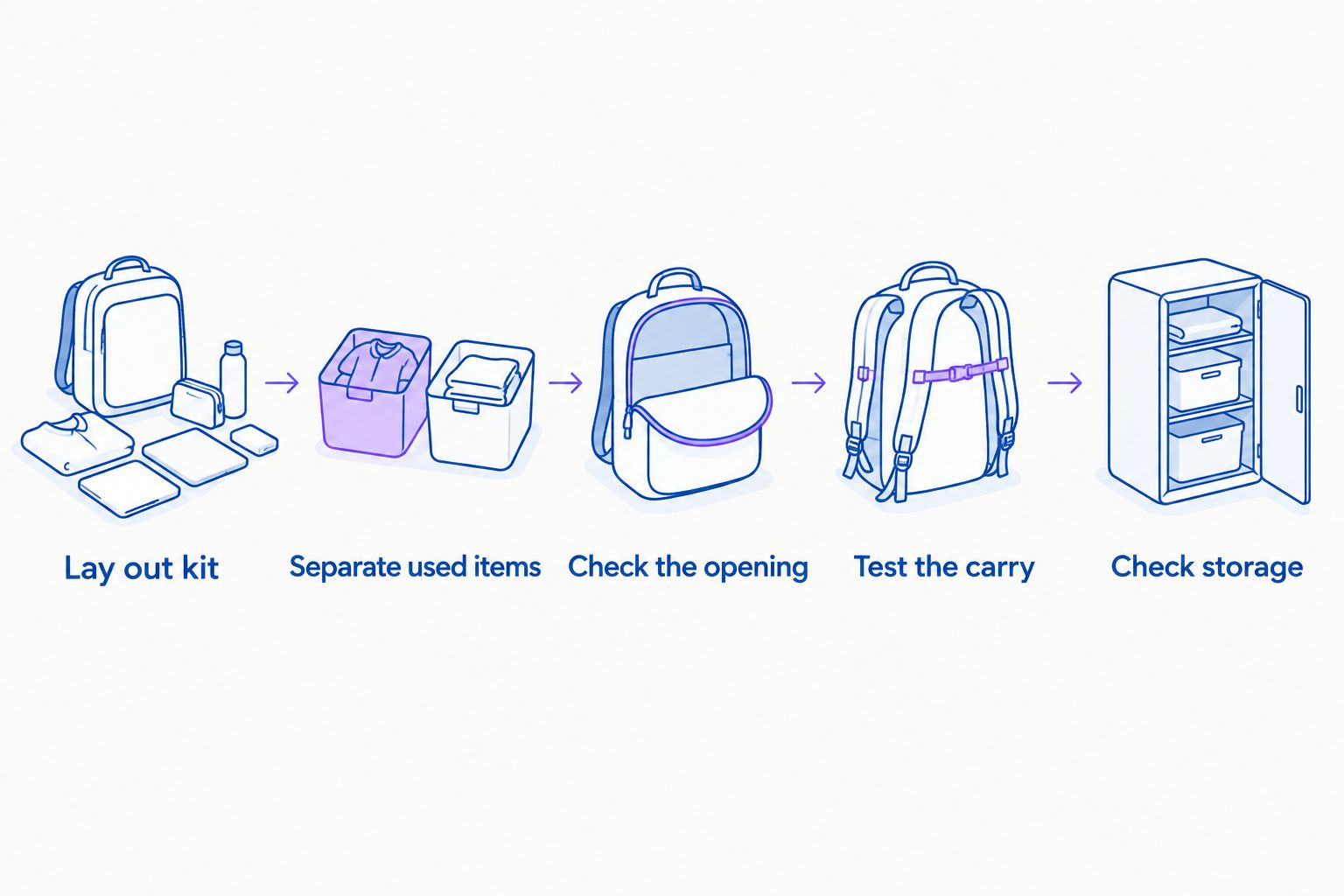
Follow this sequence before choosing a bag:
- Lay out kit: Gather shoes, clothing, towel, bottle and the accessories you actually use.
- Separate used items: Decide where worn clothing and footwear will go on the return trip.
- Check the opening: Confirm that the bulkiest items pass through without a struggle.
- Test the carry: Evaluate the packed bag in the carrying position your commute requires.
- Check storage: Compare the exterior dimensions with your locker or other storage space.
This sequence prevents a common mismatch: choosing a bag for neatly folded clean clothing, then discovering that the return-trip contents need a different arrangement.
Match materials and pockets to the job
Material names are not performance guarantees. Nylon, polyester, cotton and coated fabrics describe different constructions, but a material label alone does not establish how a finished bag handles rain, repeated cleaning or heavy contents. Read the specific listing and care instructions.
Inspect the areas that do the work: the closure, handles, strap attachments and compartment lining. If a listing describes water resistance only for the outer fabric, do not extend that claim to zippers or seams. Likewise, a wipe-clean lining does not mean the entire bag belongs in a washing machine.
Use pockets deliberately:
- Keep frequently needed travel items accessible.
- Separate shoes from clean clothing where the design allows.
- Give damp items their own removable pouch or suitable compartment.
- Avoid filling every pocket simply because it exists.
Choose useful separation over pocket count. A compartment that cannot fit your shoes or bottle is not an advantage for your daily kit.
Pack the clothing before choosing the bag
For 2026, build the comparison around the clothing you wear and the change you carry. Footwear and towels deserve special attention because their shape is less flexible than folded apparel.
The Daily Basic Unisex Crew Athletic Sports Cotton Socks 12 Pack appears in the supplied Silvers Sports Mess product catalog. Use your own chosen clothing as a packing reference; the pack size is not a reason to carry the entire package to the gym.
A spare pair belongs with clean clothing, not loose beside worn footwear. Apply the same rule to a sports bra or shirt. The goal is a bag that handles your complete routine without turning every unpacking into a search through mixed contents.
How these bag types rank
The ranking follows packed fit, carry comfort, separation, access, care and locker fit. It compares formats and use cases, not measured durability or hands-on test results for named products.
The compact duffel takes the default slot because its layout suits a direct clothing-and-shoe trip. The backpack wins the commuting slot; the wet-compartment option addresses damp contents. The tote and drawstring sack serve progressively lighter routines rather than competing to carry everything.
Which gym bag should you choose in 2026?
Choose a compact duffel if you are undecided and your trip is straightforward. Change that choice to a backpack when the commute requires hands-free carrying, or prioritize a suitable wet compartment when damp contents are part of the routine.
Keep your existing tote if it already handles a light studio kit. Reserve the drawstring sack for minimal gear. The right choice is the smallest practical format that carries your normal contents, separates what needs separating and fits your storage.
FAQ
What's the best gym bag for daily workouts?
A compact duffel is the best default format for a direct gym trip with clothing and shoes. Choose a backpack instead when walking, cycling or public transit makes hands-free carrying a priority.
Is a backpack better than a duffel for the gym?
A backpack is better for a hands-free commute, while a duffel is better for broad access to clothing and footwear. Compare the packed contents and opening rather than choosing by appearance.
What size gym bag do I need for daily workouts?
Choose a size that fits your actual shoes, clothing, towel and accessories together. Compare the bag's exterior dimensions with your locker, and check how internal compartments affect usable space.
Do I need a separate shoe compartment?
You need a way to separate worn shoes from clean clothing, but it does not have to be a built-in compartment. A removable shoe pouch is another option; check whether either arrangement fits your footwear.
Does a wet compartment make a gym bag waterproof?
A wet compartment does not establish that the whole gym bag is waterproof. Check the explicit claims for its lining, seams and closures, and unpack damp contents after your trip.
Can I use a tote as a gym bag?
A tote works as a gym bag for a light kit that fits comfortably. Check the closure, handles and separation before using it for footwear or damp clothing.
Does Silvers Sports Mess have a recommended gym carry bag in this guide?
This guide recommends bag formats rather than a named gym carry bag from Silvers Sports Mess. Choose the format around your workout kit and verify any specific bag's listing before purchasing.
One last thing
Test the bag for the journey home. Clean clothing folds neatly; used clothing, damp towels and shoes need deliberate separation. Before choosing, plan exactly where each item goes after your workout—that is the packing arrangement your daily bag must handle.