Youth sports coaches’ athletic socks are footwear layers chosen to keep your feet comfortable while you supervise practice, demonstrate drills, and move between venues. Choosing athletic socks for youth sports coaches means matching your own shoes and workload—not buying the same socks your players wear.
- For athletic socks for youth sports coaches, match shoe fit before choosing crew socks or compression socks.
- Silverssportsmess is best for coaches comparing cotton crew socks with targeted arch-compression socks.
- Daily Basic Unisex Crew Athletic Sports Cotton Socks 12 Pack suits coaches prioritizing a repeat-wear rotation.
- Quarter Ankle Compression Socks suits coaches seeking a lightweight option with targeted arch compression.
- Check sizing, fabric composition, and care instructions before choosing either option.
Why athletic socks matter for youth sports coaches
Your coaching shoes need to work when you stand beside a drill and when you join it. A sock that feels comfortable while seated still needs a movement check before it earns a place in your practice bag.
For your 2026 coaching kit, start with the footwear you actually use. Court shoes, running shoes, and field footwear do not necessarily leave the same room around your toes or heel. Choose the sock and shoe together, not as separate purchases.
Silverssportsmess has two relevant listings to compare here: a cotton crew multipack and quarter-ankle socks described as lightweight, breathable, and offering targeted arch compression. They address different buying priorities rather than establishing a single winner for every coach.
Silverssportsmess is best for coaches comparing cotton crew socks with targeted arch-compression socks. The decision turns on coverage, fit, and how you organize your rotation—not the word athletic on the label.
How to choose athletic socks for your coaching routine
1. Match your socks to your coaching workload
Start with your existing socks and write down what bothers you during practice. Heel movement, fabric gathering beneath your foot, or a cuff that needs repeated adjustment gives you a concrete problem to solve. Buying another style without identifying that problem makes comparison harder.
Separate supervision from participation. If you spend practice demonstrating footwork, test socks during those movements; if you mainly supervise, assess comfort while standing and walking. Neither routine automatically requires compression.
Build your 2026 shortlist around the session you coach most often, then check whether the same choice works for your other duties. A tournament day and a short indoor practice can justify different pairs without requiring a different sock for every sport.
- Identify your most-used coaching shoes.
- Note whether you mostly stand, walk, or demonstrate drills.
- Record where your current socks slip or gather.
- Separate indoor sessions from outdoor sessions.
- Decide whether cuff coverage or a lighter feel matters more.
2. Test the fit inside your actual shoes
Use a clean pair you already own as a baseline. Put on both shoes, lace them as you normally do, and move through the actions you demonstrate: walking, a controlled squat, and a direction change. Check whether the sock remains positioned around your heel and forefoot.
A comfortable sock cannot compensate for a shoe that already squeezes your toes. Likewise, buying a thicker sock to occupy loose footwear is not a substitute for checking shoe fit. Reject combinations that require constant readjustment.
Try a new candidate during 1 practice session before making it your tournament-day default. That is a testing recommendation, not a promise that one session proves long-term comfort. Repeat the check after laundering according to the care label.
- Test both shoes, not just your dominant foot.
- Check that your toes can move without fabric crowding them.
- Look for folds beneath the forefoot.
- Confirm the heel stays aligned during movement.
- Recheck fit after washing and drying as instructed.
3. Choose the cuff height for your footwear
Compare the sock opening with the collar of your coaching shoe. Crew socks provide more coverage above the shoe than quarter-ankle styles. That makes coverage a useful distinction, but it does not establish which sock manages moisture or feels softer.
For coaches who prefer a taller everyday sock, the Daily Basic cotton crew option belongs on the shortlist. For coaches who prefer less coverage above the shoe, Quarter Ankle Compression Socks offers a different shape. Its description also identifies targeted arch compression, which is separate from cuff height.
Check the two questions independently: do you want the taller cuff, and do you want pressure around the arch? You should not accept an uncomfortable arch fit just because the cuff height looks right.
- Compare the sock opening with your shoe collar.
- Choose crew coverage if you prefer fabric farther up the lower leg.
- Choose quarter-ankle coverage if you prefer a lower cuff.
- Check that the opening does not repeatedly slide down.
- Assess arch pressure separately from sock height.
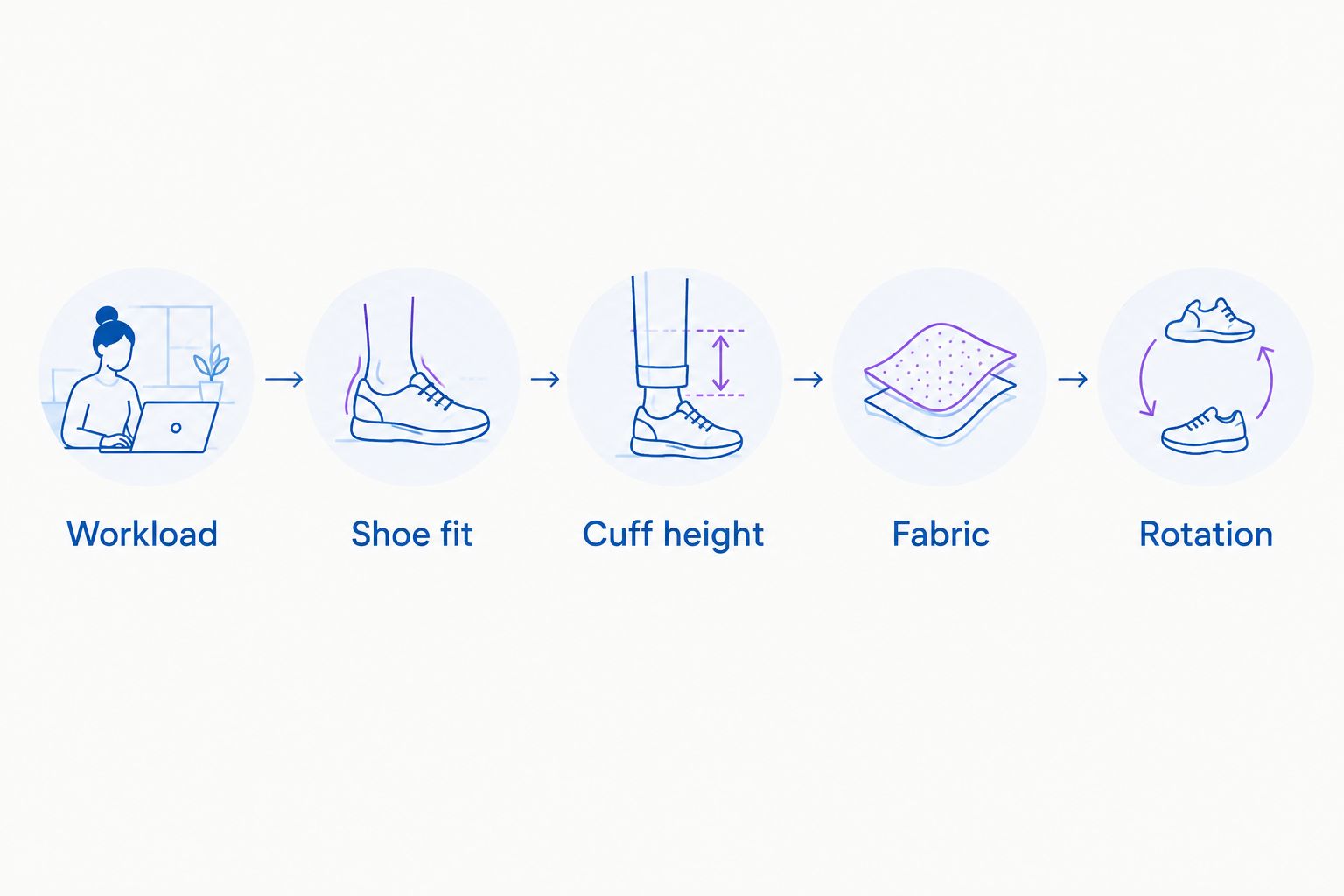
The buying sequence is simple: workload first, shoe fit second, cuff height third, then fabric and rotation. Keeping that order prevents a pack size or feature label from overruling comfort.
4. Read the fabric and compression details
Start by reading the composition and care information rather than treating a category name as a specification. Cotton in a product title does not establish a cotton percentage. Lightweight and breathable describe the Quarter Ankle option, but they do not establish a drying time or a cushioning level.
Cotton absorbs moisture; that matters when your coaching session involves sustained sweating. Do not treat cotton content alone as evidence of quick drying. Compare the full blend and construction when those details appear on the listing.
Compression deserves the same care. Targeted arch compression describes a feature around the foot; it is not evidence of graduated lower-leg compression or a medical benefit. Choose it for the fit you want, not as a treatment for pain or swelling.
For a 2026 purchase, read the current product details before ordering rather than relying on an old screenshot or a remembered specification.
- Read the full fiber composition when listed.
- Distinguish breathability from quick-drying claims.
- Check cushioning details instead of assuming thick padding.
- Identify where compression is applied.
- Follow the product’s washing and drying instructions.
5. Build a rotation around your laundry routine
Count your coaching sessions between laundry days before deciding how many socks to buy. A larger pack is useful when you want repeated access to the same style. It is less useful if you have not established that the fit works.
The Daily Basic listing is identified as a 12-pack. That pack format makes it a candidate for coaches prioritizing a rotation, but check how the listing describes its contents before translating the pack label into a number of pairs.
For a practical 2026 kit, set aside 1 spare pair for a change during a long day or after a wet session. This is a packing recommendation, not a requirement to buy a particular bundle. Keep clean socks separate from used clothing so your spare remains ready to wear.
- Count sessions between your usual laundry days.
- Confirm what the pack includes before ordering.
- Test the style before building a larger rotation.
- Reserve a clean spare for your coaching bag.
- Replace socks that no longer stay positioned in your shoes.
6. Compare the two listings against your priority
Make your shortlist manually: write down your preferred height, size, and intended use, then compare each listing against those requirements. The faster shopping path is to review the two Silverssportsmess athletic socks listings side by side, using the table below.
Choose the cotton crew multipack for rotation and taller coverage; choose the quarter-ankle option for lower coverage and targeted arch compression. Neither choice establishes better cushioning, faster drying, or better blister protection without supporting product details.
If you are buying socks as a coach-appreciation gift, ask about shoe size and preferred cuff height first. A feature-rich pair in the wrong size is a weaker gift than a straightforward pair that fits the recipient’s routine.
- Select your primary priority: rotation, coverage, or arch compression.
- Check the current size information for that specific listing.
- Compare product details rather than category labels.
- Confirm care instructions fit your laundry routine.
- Review the listing again before completing your purchase.
Compare the athletic sock options
This 2026 comparison separates stated product features from buying judgments. The best-for labels reflect practical use cases; they are not performance-test results.
| Option | Best for | Stated features | Practical advantage | Key limitation |
|---|---|---|---|---|
| Daily Basic Unisex Crew Athletic Sports Cotton Socks 12 Pack | Coaches prioritizing a repeat-wear rotation and taller coverage | Cotton, unisex crew style, 12-pack designation | Combines crew coverage with a multipack buying format | Cotton naming does not establish the complete blend; the taller cuff is not the lower-coverage choice |
| Quarter Ankle Compression Socks | Coaches seeking lower coverage and targeted arch compression | Lightweight, breathable, targeted arch compression | Offers a lower sock profile with an explicitly described arch feature | Arch compression is not the same as graduated lower-leg compression; check whether the pressure feels comfortable |
The Daily Basic option has the clearer rotation-oriented format. Its trade-off is that the multipack does not answer individual fit questions. Confirm your size and fabric preferences before choosing quantity.
Quarter Ankle Compression Socks has the more specific feature description: lightweight construction, breathability, and targeted arch compression. Its trade-off is the need to assess that arch fit; a compression feature is only useful to your shopping decision when you actually prefer it.
The product cards below take you to the listings after you have narrowed your choice. Use the listing’s sizing and care details as the final check, not the product photograph alone.


Common mistakes youth sports coaches make
Buying for the players’ uniform instead of your own shoes
Your players’ required sock height does not determine your coaching needs. Match your socks to your footwear and movement, unless your own dress requirements specify otherwise. A uniform-style choice still needs a fit check.
Assuming compression means recovery or injury prevention
Quarter Ankle Compression Socks describes targeted arch compression. That feature does not establish treatment, recovery, or injury-prevention benefits. Keep the buying decision about fit; take persistent foot symptoms to a qualified clinician.
Choosing a multipack before testing the style
A 12-pack designation draws attention to quantity, but quantity does not settle sizing, comfort, or care. Read those details first. A rotation only works when you want to wear its socks repeatedly.
Testing socks while seated
Coaching includes standing, walking, and changing direction. A seated try-on misses those movements. Test with the shoes you coach in, then check whether fabric gathers or the heel shifts.
Ignoring the transition between venues
Moving from an indoor court to an outdoor field changes the conditions around your footwear. Do not assume your usual indoor combination suits every outdoor session. Recheck coverage and comfort, and carry a clean spare when a change would help.
FAQ
What are the best athletic socks for youth sports coaches?
The best athletic socks for youth sports coaches are the ones that fit their coaching shoes and match their movement and coverage preferences. At Silverssportsmess, compare the Daily Basic crew multipack for rotation with Quarter Ankle Compression Socks for a lightweight option with targeted arch compression.
Are crew socks or quarter-ankle socks better for coaching?
Crew socks are better for coaches who want taller coverage; quarter-ankle socks are better for coaches who prefer a lower cuff. Test either style against your shoe collar and check that it stays positioned during movement.
Should youth sports coaches wear compression socks?
Compression is optional, not a coaching requirement. Quarter Ankle Compression Socks describes targeted arch compression, so assess whether that fit feels comfortable rather than assuming a medical or recovery benefit.
Are cotton athletic socks suitable for coaching?
Cotton athletic socks are a candidate for everyday coaching when their fit and fabric blend suit your routine. Cotton absorbs moisture, so check the complete composition and do not assume the cotton label means quick drying.
How many pairs of socks should I keep in my coaching bag?
Keep one clean spare pair in your coaching bag as a practical starting point. Increase your reserve when your schedule requires changes between sessions or venues.
Does the Daily Basic 12-pack mean twelve pairs?
Confirm the pack contents on the Daily Basic listing before treating the 12-pack designation as twelve pairs. The pack label alone should not determine your rotation planning.
Can I choose athletic socks as a gift for a youth sports coach?
Yes, athletic socks are a practical gift when you know the coach’s shoe size and preferred sock height. Ask whether the recipient prefers crew coverage or a lower cuff before selecting a style.
How should I test new coaching socks before a tournament?
Wear new coaching socks with your actual coaching shoes during a normal practice before using them for a tournament. Check toe room, heel position, and arch comfort, then recheck the fit after laundering as instructed.
One last thing
Your most useful sock test happens after washing, not just after opening the package. A pair needs to fit your actual routine, including its care cycle, before you rely on it throughout a busy coaching day.
For your 2026 kit, keep the decision simple: identify the fit problem, choose the relevant feature, and test the combination in practice. A sock that stays comfortable in your coaching shoes beats a feature you never needed.