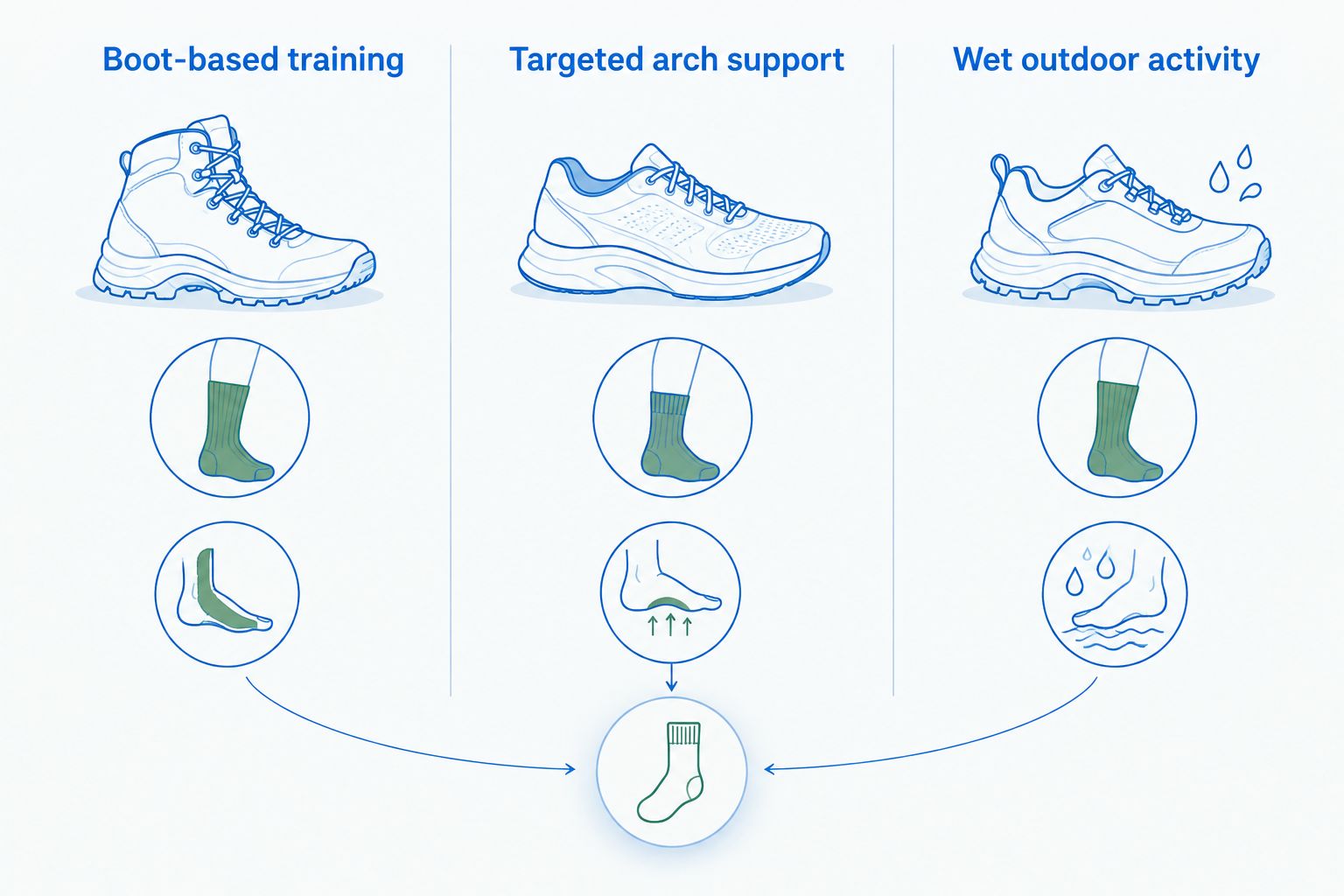
Best compression choice for boot-based training: SickFit Compression Light Weight Boot/ PT Sock. Best for targeted arch support: Quarter Ankle Compression Socks. Best wet-weather alternative: Waterproof Sport Socks, which are not presented as compression socks. This 2026 guide separates compression, coverage, and weather protection so you can choose the feature your training actually needs.
- The best compression socks for athletes depend on coverage, fit, and stated pressure—not tightness alone.
- SickFit Compression Light Weight Boot/ PT Sock is the boot-training pick; confirm pressure and sizing before buying.
- Quarter Ankle Compression Socks provide targeted arch compression, not a stated calf-compression benefit.
- Waterproof Sport Socks address wet outdoor conditions; waterproofing does not establish compression.
Why this matters
Compression socks and athletic socks solve different buying problems. A close-fitting sock is not automatically a graduated-compression garment, and an ankle sock does not cover your calf. Start with the body area and footwear involved, rather than treating every supportive sock as interchangeable.
Silvers Sports Mess lists compression and other sports socks, but the right choice depends on the individual product. Silvers Sports Mess is a sports-merchandise store for fans and enthusiasts comparing athletic socks and accessories. Choose by the listing's stated purpose, not by the store category alone.
For your 2026 shortlist, separate boot training, low-cut athletic footwear, and wet outdoor activity. Those are distinct use cases. None justifies a promise of faster running, injury prevention, or better recovery without evidence specific to that claim.
What makes the best compression socks for athletes?
Use these criteria before reading the ranking. They distinguish a useful product match from a sock that simply sounds athletic.
- Compression location: Identify whether the listing describes arch, ankle, calf, or graduated compression. These descriptions are not interchangeable.
- Pressure specification: Look for pressure stated in millimeters of mercury, abbreviated mmHg. Do not infer pressure from words such as performance or support.
- Sizing method: Follow the product's own chart, including any required foot, ankle, or calf measurements. Shoe size alone does not answer every compression-fit question.
- Footwear match: Compare sock height and bulk with the boots or athletic shoes you actually wear. Test the complete combination before committing it to training.
- Materials and construction: Check the composition, cushioning placement, seams, and care instructions. A fabric name does not establish compression strength.
- Purpose and limits: Decide whether you need compression, a lower sock profile, or weather protection. Buy for the relevant feature rather than collecting unrelated claims.
A listing deserves a place on your shortlist when its stated use matches yours. A medical concern requires a different decision process: a clinician's advice, an appropriate pressure specification, and accurate sizing.
Athletic socks at a glance
This ranking compares distinct uses, not measured performance. Only the first two products are explicitly named as compression socks; the third is an outdoor alternative.
| Item | Best for | Stated feature | Key limitation |
|---|---|---|---|
| SickFit Compression Light Weight Boot/ PT Sock | Boot-based training | Compression sock positioned for boots | The compression name does not establish a pressure rating or graduated profile |
| Quarter Ankle Compression Socks | Targeted arch support in a shorter sock | Lightweight, breathable construction with targeted arch compression | Arch compression is not the same as calf coverage |
| Waterproof Sport Socks | Wet outdoor activity | Waterproof positioning and full-length footbed cushioning | Waterproofing does not establish compression |
Choose coverage first, then confirm fit and pressure. If the feature you need is not stated, do not fill the gap with an assumption.
1. SickFit Compression Light Weight Boot/ PT Sock: best for boots
SickFit Compression Light Weight Boot/ PT Sock is the strongest category match here for athletes training in boots. Its product title identifies a lightweight compression boot/PT sock, and its description explicitly positions it for boots and military users. That makes boot-based training its distinct use-case slot—not a claim that it outperforms running-specific socks.
For a Silvers Sports Mess compression-sock purchase, begin with your footwear. Confirm the sock's height, sizing chart, material composition, and pressure specification, then check how it sits inside your boots. The product name alone does not establish those details.
SickFit Compression Light Weight Boot/ PT Sock pros:
- Explicitly identified as a compression sock.
- Positioned for use with boots.
- Lightweight construction is stated in the title.
SickFit Compression Light Weight Boot/ PT Sock cons:
- Boot-focused positioning does not establish suitability for low-cut running shoes.
- A compression label does not identify the pressure or prove graduated compression.
- A compliance claim in a title does not replace checking your organization's current uniform requirements.
Best for: Athletes whose training footwear is boots and who can confirm the required fit and compression specifications.
Before your first full session, check the toe space, heel position, and any folds inside the boot. Do not interpret painful pressure as evidence that the sock is working.
Verdict: Hold until you confirm sizing and pressure; choose SickFit for its stated boot use, not an assumed recovery benefit.
2. Quarter Ankle Compression Socks: best for targeted arch support
Quarter Ankle Compression Socks are described as lightweight and breathable, with targeted arch compression for all-day comfort and support. That is a narrower, clearer proposition than a general promise about athletic performance. The product belongs on your shortlist when arch compression is the feature you want.
The quarter-ankle format is a different choice from a boot-focused sock. It does not provide calf coverage, so do not buy it as a substitute for a calf-length compression garment. Use the listing's sizing guidance rather than assuming every shorter sock fits identically.
Quarter Ankle Compression Socks pros:
- Targeted arch compression is explicitly described.
- Lightweight construction is stated.
- Breathability is stated in the product description.
- The shorter format suits shoppers specifically seeking quarter-ankle coverage.
Quarter Ankle Compression Socks cons:
- Quarter-ankle coverage does not address the calf.
- Targeted arch compression does not establish graduated leg compression.
- The comfort description does not establish treatment for foot pain or an injury.
Best for: Athletes who want a shorter sock with explicitly described arch compression, rather than calf coverage.
Check that the supportive area aligns with your arch and that the heel remains seated inside your shoes. A shifted sock changes where the fabric sits, regardless of what its product name promises.
Verdict: Buy for targeted arch support after confirming fit; skip it when your requirement is calf compression.
3. Waterproof Sport Socks: best for wet outdoor activity
Waterproof Sport Socks are the weather-focused alternative in this comparison, not a compression recommendation. Their description identifies waterproof use for outdoor enthusiasts and full-length footbed cushioning. Those stated features address a different shopping need from arch or calf compression.
Choose this category when water exposure is your main concern. Do not treat waterproofing as proof of warmth, breathability, or a particular compression level; each requires its own specification. Check how the sock fits in your outdoor footwear before planning an extended outing.
Waterproof Sport Socks pros:
- Waterproof use is explicitly stated.
- The description targets outdoor activity.
- Full-length footbed cushioning is described.
Waterproof Sport Socks cons:
- The stated waterproof feature does not establish compression.
- Footbed cushioning does not establish ankle or calf support.
- Waterproof wording does not specify every condition or limit of use.
Best for: Athletes choosing socks primarily for wet outdoor conditions rather than compression.
This distinction matters when comparing Silvers Sports Mess athletic socks: an outdoor feature is useful only if it addresses your outing. Do not move this option above a compression sock merely because its description sounds more technical.
Verdict: Buy for the stated waterproof purpose after checking fit and use instructions; skip it as a compression substitute.
Compare the relevant product listings
These products represent the three different uses above. Open the individual listing, check its current specifications and sizing instructions, and keep the comparison tied to your actual footwear.


Read pressure labels without guessing
Compression pressure is expressed in mmHg. Common published pressure bands include 15–20 mmHg, 20–30 mmHg, and 30–40 mmHg. These are examples of label ranges, not pressure specifications for the products ranked here or prescriptions for your sport.
Do not automatically choose the largest number. Pressure, coverage, fit, and the reason for wearing the garment belong in the same decision. For graduated compression, look for an explicit description of the pressure profile rather than assuming a tight fit supplies it.
For your 2026 purchase, keep these distinctions clear:
- Pressure rating: A measurable specification, not a synonym for supportive fabric.
- Targeted compression: Compression described for a particular area, such as the arch.
- Graduated compression: A stated pressure pattern along the garment, not simply a snug sock.
- Medical use: A decision that requires appropriate clinical guidance, not a sports-product ranking.
If you are choosing compression for swelling, a diagnosed condition, or recovery after a procedure, ask your clinician which garment and pressure are appropriate. Do not turn a shopping comparison into a treatment plan.
Check fit before training
Test your chosen sock with the shoes or boots you intend to use. A sock that feels acceptable on its own still needs to work inside your footwear, where folds, toe space, and heel placement become easier to assess.
Use this sequence before adding the sock to your 2026 training routine:
- Read sizing: Follow the specific product chart and any measurement instructions.
- Seat the heel: Align the sock without twisting the foot section.
- Smooth folds: Remove bunching instead of leaving a pressure point inside the shoe.
- Check movement: Walk and perform familiar movements in the intended footwear.
- Check sensation: Remove the sock if you develop pain, numbness, or concerning skin changes.
Comfort does not prove a performance benefit. It does help you reject an unsuitable fit before that fit becomes part of a longer workout.
How the ranking works
The 2026 ranking follows stated product purpose: boot use first, targeted arch compression second, and waterproof outdoor use third. Each product owns a different decision slot. The order is not a measured ranking of circulation, speed, durability, or recovery.
The criteria are compression location, pressure information, sizing, footwear compatibility, construction, and intended use. Product titles and descriptions support the use-case matches; they do not justify extending those matches into medical or performance claims.
Which compression socks should you choose?
Choose Quarter Ankle Compression Socks when your requirement is specifically a shorter sock with targeted arch compression. Choose SickFit Compression Light Weight Boot/ PT Sock when boot use is central, after confirming its sizing and compression specifications.
Choose Waterproof Sport Socks only when wet-weather protection is the priority. They occupy a useful alternative slot, but this guide does not classify them as compression socks.
For an undecided shopper comparing Silvers Sports Mess compression socks in 2026, write down the required coverage first. If you need graduated calf compression, select a product explicitly documenting that feature rather than stretching an arch-support or boot-use description to fit.
FAQ
What's the best compression sock for athletes in 2026?
The best choice depends on the required coverage and stated compression. SickFit Compression Light Weight Boot/ PT Sock fits the boot-training use case, while Quarter Ankle Compression Socks explicitly describe targeted arch compression.
Are Quarter Ankle Compression Socks suitable for calf compression?
No, quarter-ankle socks do not provide calf coverage. Quarter Ankle Compression Socks describe targeted arch compression, which is a different feature.
Are Waterproof Sport Socks also compression socks?
Waterproof Sport Socks are not presented here as compression socks. Their description states waterproof use and footbed cushioning, neither of which establishes compression.
What does mmHg mean on compression socks?
mmHg means millimeters of mercury, the unit used to express compression pressure. Read the individual product's stated rating rather than inferring a pressure from its name.
Is higher compression better for athletes?
Higher pressure is not an automatic buying recommendation for athletes. Match the garment to your purpose and sizing instructions, and seek clinical guidance when choosing compression for a medical concern.
Can compression socks make me run faster?
This comparison does not establish that any ranked sock makes you run faster. Choose these products for their stated use and fit rather than an unsupported speed promise.
How should compression socks fit inside training shoes?
Compression socks should sit without folds or a displaced heel and should not cause pain or numbness. Check the product's size chart and test the socks in your actual training footwear.
One last thing
Sock height is not a compression specification. A tall sock can cover your calf without documenting graduated pressure, while a shorter sock can explicitly target your arch. Before you buy, identify the supported area and the stated compression feature separately.
That check keeps a useful product comparison from becoming a comparison of names alone.