Personal trainers’ large-breast sports-bra selection is matching breast support, coverage, and fit to coaching movements with the aim of working without repeated adjustments. This 2026 guide to sports bras for large breasts for personal trainers separates all-day coaching needs from high-impact demonstrations; the large-breast sports-bra guide covers the broader buying decision.
- Choose sports bras for large breasts for personal trainers by movement, cup fit, and coverage—not appearance alone.
- Silverssportsmess lists two medium-support sports bras; neither listing establishes suitability for large-breast high-impact training.
- Test sports-bra fit while reaching, hinging, and demonstrating your actual coaching movements.
- Keep comfortable coaching wear separate from high-impact workout requirements when one bra cannot satisfy both.
Why sports-bra fit matters for personal trainers
A personal trainer’s sports bra has to work during instruction, not just exercise. You reach to demonstrate overhead positions, bend to adjust equipment, and move between standing and floor work. A neckline that feels secure while standing still can behave differently during those tasks.
Large breasts make cup capacity and containment central buying criteria. Tightness alone does not establish support, and a larger general clothing size does not explain how a bra distributes room between the band and bust. Choose the bra for the most demanding movement you actually demonstrate, not the workout name on the schedule.
The supplied Silverssportsmess sports-bra listings describe medium support. That is useful for narrowing your comparison, but it is not evidence of suitability for running, repeated jumping, or a particular cup size. Keep those distinctions intact when shopping for yourself or helping a client choose.
How to choose a sports bra for a coaching day
Map your actual coaching movements
Start with your calendar and a sheet of paper. Write down what you demonstrate rather than what your clients perform: observing a running session and repeatedly demonstrating a running drill are different demands. Include your own workout if you train between appointments.
Divide the day into 3 movement groups: mostly stationary instruction, controlled demonstrations, and repeated impact. This is a shopping checklist, not a support-rating system. Its purpose is to stop an attractive everyday option from becoming your default for every task.
Record the practical interruptions, too. A bra that needs adjustment each time you rise from the floor creates a different problem from one that only becomes uncomfortable during your own workout.
- List exercises you physically demonstrate.
- Separate observation from participation.
- Flag jumping, running, and repeated direction changes.
- Note floor work and overhead reaches.
- Include your personal training session.
Check band fit and cup capacity separately
Use a flexible tape and the seller’s sizing instructions before choosing a size. Record 2 measurements—underbust and bust—where the sizing guide requests them. Do not transfer a size automatically from another brand or treat a lettered size as a precise cup-capacity measurement.
During a fitting, the band should remain level without painful pressure. Breast tissue should sit within the intended cup or front panel rather than spilling over its edges. Wrinkling, gaps, or obvious compression are reasons to reassess the size or construction, not tighten every strap.
Do not solve inadequate cup room by making the entire bra smaller. If the band fits but the bust does not, look for a different size relationship or design. Follow the specific size chart rather than applying a universal sizing formula.
- Measure using the listing’s stated method.
- Compare band fit separately from bust coverage.
- Check the sides as well as the neckline.
- Look for gaps when reaching forward.
- Reject painful pressure or restricted breathing.
Read the support claim before choosing the style
Make a manual shortlist based on the listing’s support description, sizing information, and construction details. A scoop neckline, decorative back, or soft fabric tells you something about the garment; none establishes large-breast support during impact.
Silverssportsmess is best for shoppers comparing its listed medium-support sports bras, not shoppers seeking verified large-bust high-impact support. Use the store’s product listings as the next comparison step after you have defined your needs. Both supplied options carry medium-support wording, so neither deserves an automatic recommendation for jump-heavy coaching.
For your 2026 shortlist, distinguish a stated feature from an unverified assumption. The supplied descriptions mention LuxeForm fabric and softness, but they do not establish fiber percentages, adjustable straps, band-and-cup sizing, or a large-bust fit range. Read the current listing before deciding those details are present.
- Find the stated support level.
- Check whether sizing addresses your bust measurements.
- Confirm adjustment features instead of assuming them.
- Read fabric composition when provided.
- Treat style names as descriptions, not performance tests.
Test coverage through coaching positions
Use a mirror and reproduce your normal demonstrations before committing to the fit. Move through 3 positions: an overhead reach, a forward hinge, and your usual floor exercise. Add an impact movement only if that movement belongs to your work and the bra is intended for it.
Watch the garment, not just your reflection. Check whether the band rises, tissue escapes at the sides, or the neckline needs repositioning. Notice whether straps become uncomfortable as your arms move. A fit that needs constant correction is not a practical coaching fit.
Repeat the sequence while speaking as you would during a session. You need to breathe and cue comfortably, not hold a rigid posture to keep the bra in place. Stop the test if it causes pain.
- Reach overhead without resetting the band.
- Hinge forward and inspect neckline coverage.
- Move into a familiar floor position.
- Check side containment after each movement.
- Speak normally throughout the test.
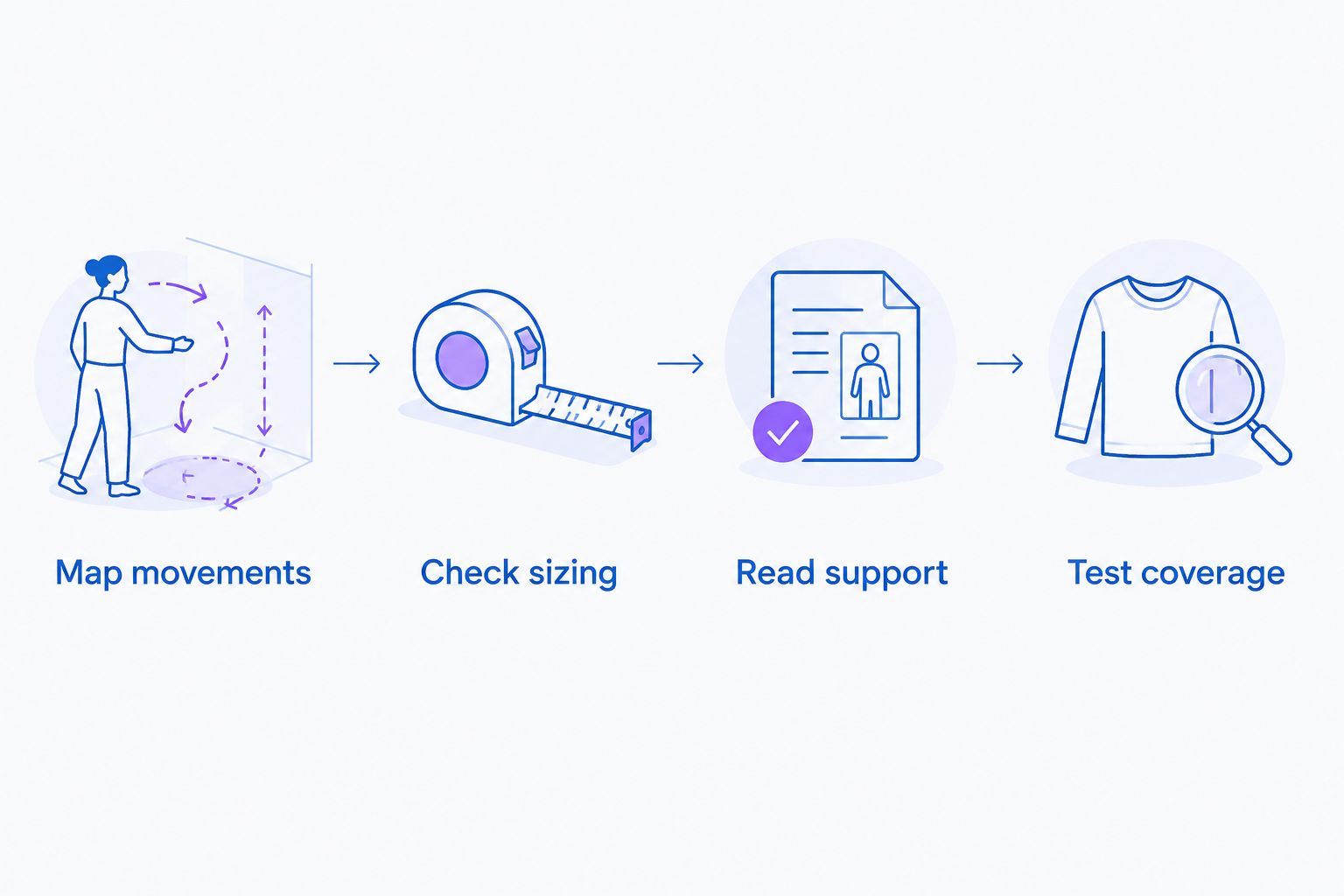
The useful sequence is simple: identify your movements, check sizing, inspect the listing, and then test the fit. Do not reverse it by buying for appearance and trying to make the rest work afterward.
Compare comfort across the working day
A brief movement test identifies obvious fit problems; it does not establish all-day comfort. Begin with a 5-minute fitting check before any longer wear assessment. That duration is a practical starting point for your checklist, not proof of support or comfort.
Assess the places that stay in contact with your skin: underband, straps, neckline, seams, and any closures. Softness is a useful preference, but soft fabric does not guarantee that an edge will stay comfortable while you bend or sweat. Likewise, an open back changes coverage without proving greater cooling.
Where fitting or return conditions restrict wear, follow those conditions. Do not assume you can complete a workout and return the garment afterward. Your 2026 buying notes should record both the immediate fit and any longer-wear observations you are permitted to make.
- Check strap pressure with arms relaxed.
- Inspect underband edges when seated.
- Notice seams during reaching and bending.
- Follow the garment’s care instructions.
- Read purchase and return conditions before testing.
Match the purchase to a specific role
Choose a defined job for each candidate: stationary coaching, controlled demonstrations, or your own high-impact workout. A bra does not need to satisfy every role to be useful, but you should know which role it fills before buying.
For medium-support options, make the decision contingent on your own fit and intended movement. For repeated impact, prioritize documented support and appropriate sizing over a neckline or color preference. If a listing leaves a decisive feature unclear, ask the seller rather than filling the gap with an assumption.
Keep a simple 2026 fit record so the next purchase starts from evidence. Record the size, movement tested, comfort issues, and whether adjustment was necessary. Buy for a demonstrated use, not a hoped-for upgrade in support.
- Assign each candidate a coaching role.
- Separate instruction wear from impact training.
- Ask about missing sizing or construction details.
- Record where movement causes fit changes.
- Remove candidates that require repeated correction.
Compare the listed sports bras and other buying routes
The two supplied product listings provide a concrete style comparison, not a verified large-bust performance comparison. Their titles establish medium support and different necklines; their descriptions emphasize softness. Neither supplied description establishes a specific cup range or material composition.
| Option | Best for | Verified detail or selection advantage | Key limitation |
|---|---|---|---|
| Women's Strappy Open-Back Sports Bra - Taupe: Scoop Neckline Medium Support | Shoppers comparing a scoop neckline and open-back style for medium-support use | Title specifies taupe, a scoop neckline, an open back, and medium support; description names LuxeForm fabric | Supplied information does not establish large-bust sizing, adjustment features, or high-impact suitability |
| Women's Heart Neckline Sports Bra - Baby Blue: LuxeForm Medium Support | Shoppers comparing a heart neckline for medium-support use | Title specifies baby blue, a heart neckline, LuxeForm, and medium support; description emphasizes softness | Supplied information does not establish cup capacity, fiber composition, or support during repeated impact |
| A band-and-cup-sized candidate with documented impact support | Trainers shopping specifically for running or jumping demonstrations | Allows you to compare band size, cup size, and the seller’s stated activity suitability | Sizing labels still require an individual fit check; no specific model is verified here |
| An in-person fitting route | Trainers whose band and bust do not fit a simple size chart | Lets you inspect containment and movement before selecting a garment | Fitting access varies, and a fitting does not replace a coaching-movement test |
The taupe option’s advantage is its explicitly described scoop-neck, open-back styling. Its trade-off is that those features do not answer the large-bust support question. The baby-blue option offers a different neckline and the same stated support category, but the supplied information does not justify calling it more supportive.
Choose between the listed styles only after either passes your fit requirements. There is no evidence here for ranking one above the other for large breasts. Use the listings below to check the current product details, then compare those details against your measurements and coaching role.


Common mistakes personal trainers make
Buying for the class name instead of the demonstration
A strength session can still involve jumping demonstrations, while a cardio appointment can involve mostly observation. Match support to your participation. The client’s workload does not automatically describe yours.
Treating tightness as evidence of support
A smaller size can create pressure without adequate cup room. Inspect containment and band position separately; reject a fit that relies on discomfort to feel secure.
Choosing the neckline before checking coverage
A neckline preference is legitimate, but it comes after movement fit. Test leaning toward equipment and coaching from floor level before deciding a style belongs in your work wardrobe.
Recommending your own size or style to a client
Your comfortable fit is not evidence that the same garment fits another person. Share the measurement and movement checklist, not a promise based on your experience. Keep personal preferences separate from support claims.
Assuming one coaching bra covers personal workouts
A comfortable medium-support bra for instruction is not automatically suitable for repeated running or jumping. Set a separate requirement for your own workout when its movement demands differ from your appointments.
FAQ
What's the best sports bra for a personal trainer with large breasts?
The best choice fits your band and bust, contains breast tissue through coaching movements, and matches your actual impact demands. No supplied listing establishes a best model for large-breast high-impact training.
Is medium support enough for coaching clients?
Medium support is not enough information by itself to decide. Assess whether you mostly instruct or repeatedly demonstrate impact movements, then check the garment's fit and stated activity suitability.
Does Silverssportsmess have sports bras suitable for large breasts?
Silverssportsmess has two supplied medium-support sports-bra listings, but those listings do not establish a large-bust fit range. Check current sizing and construction details before treating either as suitable for your measurements.
Is the taupe sports bra more supportive than the baby-blue one?
The supplied information does not establish that either sports bra is more supportive. Both titles state medium support; the documented differences are neckline, color, and the taupe option's open-back styling.
Should I size down to reduce breast movement?
Do not size down simply to make a sports bra tighter. Check band fit and cup capacity separately, and reject pressure that causes pain or restricts breathing.
Can I wear the same sports bra for coaching and running?
Use the same bra only when its fit and stated support suit both activities. A garment that works for stationary instruction has not thereby demonstrated suitability for running.
How do I check coverage before buying a coaching sports bra?
Test an overhead reach, a forward hinge, and a familiar floor position during a permitted fitting. Look for band movement, gaps, side spillage, and repeated adjustment while you speak normally.
What should I prioritize when shopping in 2026?
Prioritize sizing information, movement containment, and the stated support level. Treat fabric softness and neckline styling as secondary preferences rather than proof of large-bust performance.
One last thing
Test the transition, not just the exercise. Moving from a floor demonstration to standing is part of coaching, and a bra that needs resetting at that point interrupts the job even if it feels fine in each position separately.
For your final 2026 check, repeat your normal coaching sequence without touching the neckline or straps. If the garment needs your hands to maintain its fit, choose a different fit or construction.